MarTech ⚡️ Guide 2025

MarTech sets the pulse of marketing. Come with us into the heart chamber of the new digital communication and learn everything you need to know about marketing technology to use it successfully for yourself and your company.

M

arketing technology, or MarTech for short, on the one hand means that we are using more and more technologies for higher-performing, measurable marketing. By now, marketers use SaaS software, online tools, and apps every day. On the other hand, rapid AI development shows that marketing is changing fundamentally through technologies and new digital communication channels. Technology is not merely an instrument and a means to an end—no, it defines the nature of marketing and how we as marketers act and think.

Come along on a short MarTech journey! You’ll learn the most important things you need to know about marketing technology: How do I set myself and my marketing team up in a contemporary way? How do I use MarTech strategically? And how do I make the right selection of MarTech providers and combine them into a MarTech stack?

Welcome on the journey through the MarTech world!

MarTech Guide Topics

Back to the Future: Why does MarTech even exist?

Yes, the blessed days of marketing, when everything was still clear and tidy, are not that long ago for many older marketers. The focus was on creativity and campaigns within the AIDA model. Then “digitalization,” “the internet,” “social media,” and “artificial intelligence” appeared and have been turning everything upside down almost daily. These days, everyone is simultaneously a sender and a receiver of content and messages—one-way street no more.

It quickly became clear that the advantages outweighed the drawbacks: you could learn much more about your own customers, target them directly with messages 24/7, publish videos very easily—and with every new channel, with every new platform, countless new opportunities were added. Truly major challenges.

To be able to act, to create order, and to make the best possible use of the options that emerged, marketing had to become just as technological and software-driven as the world was becoming through the internet.

It began in the 1990s with the first newsletter tools and content management systems (CMS). The triumphal march of MarTech really picked up speed from around 2010 and has been rolling on relentlessly ever since. And the potential of artificial intelligence and machine learning has so far not even been tapped in the slightest…

What is MarTech? A brief definition.

There is no single, uniform definition. So here is a brief explanation for orientation.

You can also find more on the MarTech definition here

The term MarTech (Marketing Technology) encompasses all software and technical tools used to plan, execute, and measure marketing activities.


These technologies help achieve marketing goals more effectively and efficiently. With MarTech, for example, processes are automated, data is collected, performance analyses are carried out, and content is delivered to the target audience.

The endless areas of application for MarTech: Which platforms and providers are there?

There is no longer any area in marketing that can work successfully without the support of software and tools. Together, we look at every corner of marketing operations and, everywhere, find at least a handful of use cases for suitable technical instruments.

Here is a certainly incomplete (at Matchilla there are over 125 marketing match categories)
list of typical MarTech solutions:

Content Management Systems (CMS)
WordPress, Drupal, Joomla
Customer Relationship Management (CRM)
Salesforce, SAP, Oracle
Marketing Automation
Adobe Marketing Cloud, HubSpot, Evalanche
Web & Analytics Tools
Google Analytics, Looker, Matomo
SEO
Semrush, Sistrix, Ryte
Social media tools
Hootsuite, Facelift, Sprout Social
Content Marketing
ContentStudio, Contently, Scompler
Email Platforms
Mailchimp, Sendinblue, Constant Contact
Chatbots
IBM Watson Assistant, Intercom, Zendesk
Customer Data Platform (CDP)
Piwik Pro, Segment, Acquia
DAM, PIM & MRM
Celum, Akeneo, Wrike
Interactive Content
SurveyMonkey, Outgrow, Ion
AdTech
AdRoll, StackAdapt, Criteo
Sales Automation & Enablement
Seismic, Highspot, Showpad
Events, Meetings & Webinars
Zoom, Microsoft Teams, GoToMeeting
Artificial Intelligence
ChatGPT, genei.ai, Dall-E 2, DeepL
Voice Search Assistants
Siri, Google Assistant, Alexa, Cortana
Brand Management Software
Frontify, Canva, censhare
ESG Software
IBM Envizi, Microsoft for Sustainability, Persefoni

Booming MarTech Landscape: Mapping marketing technologies.

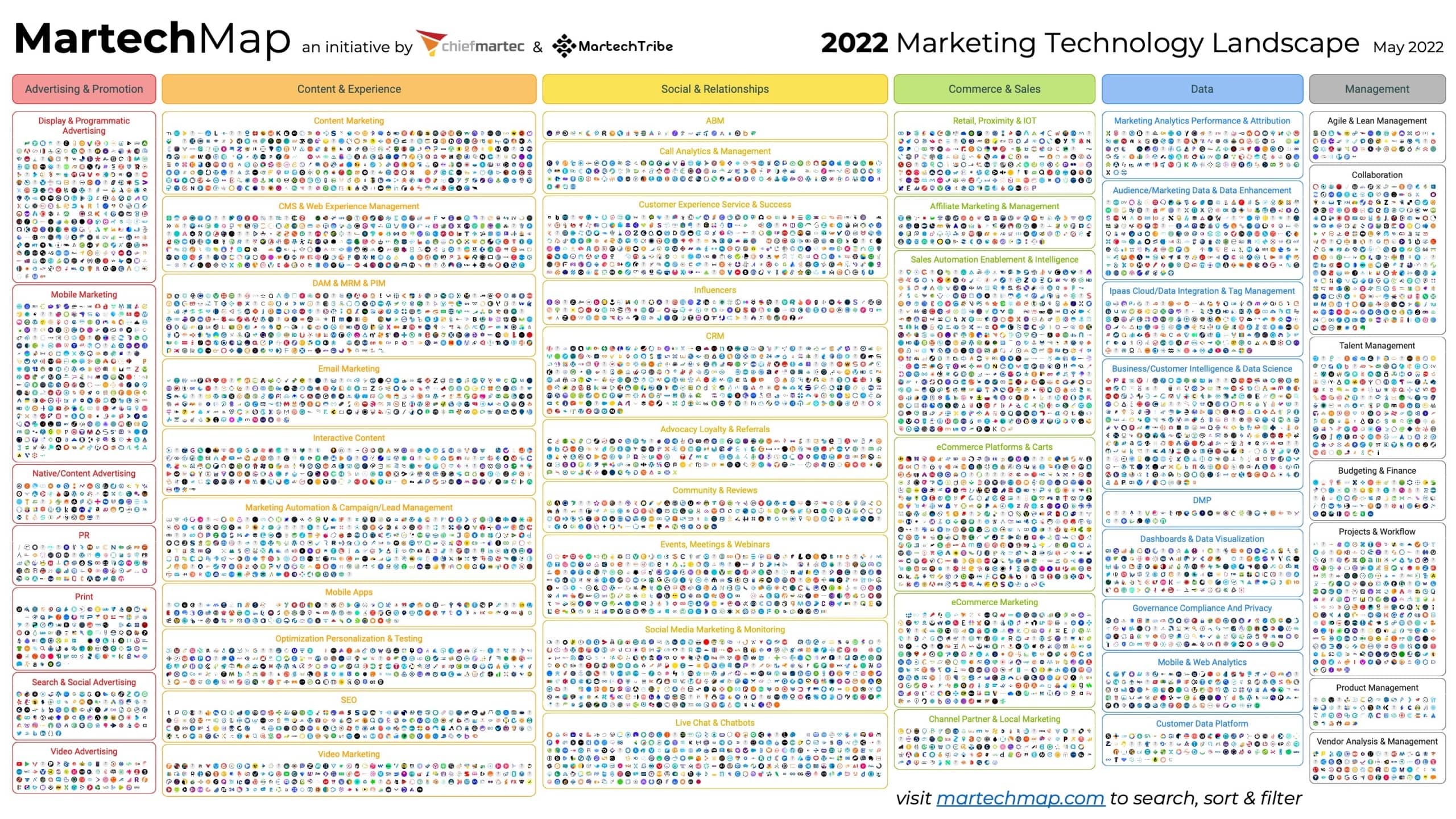
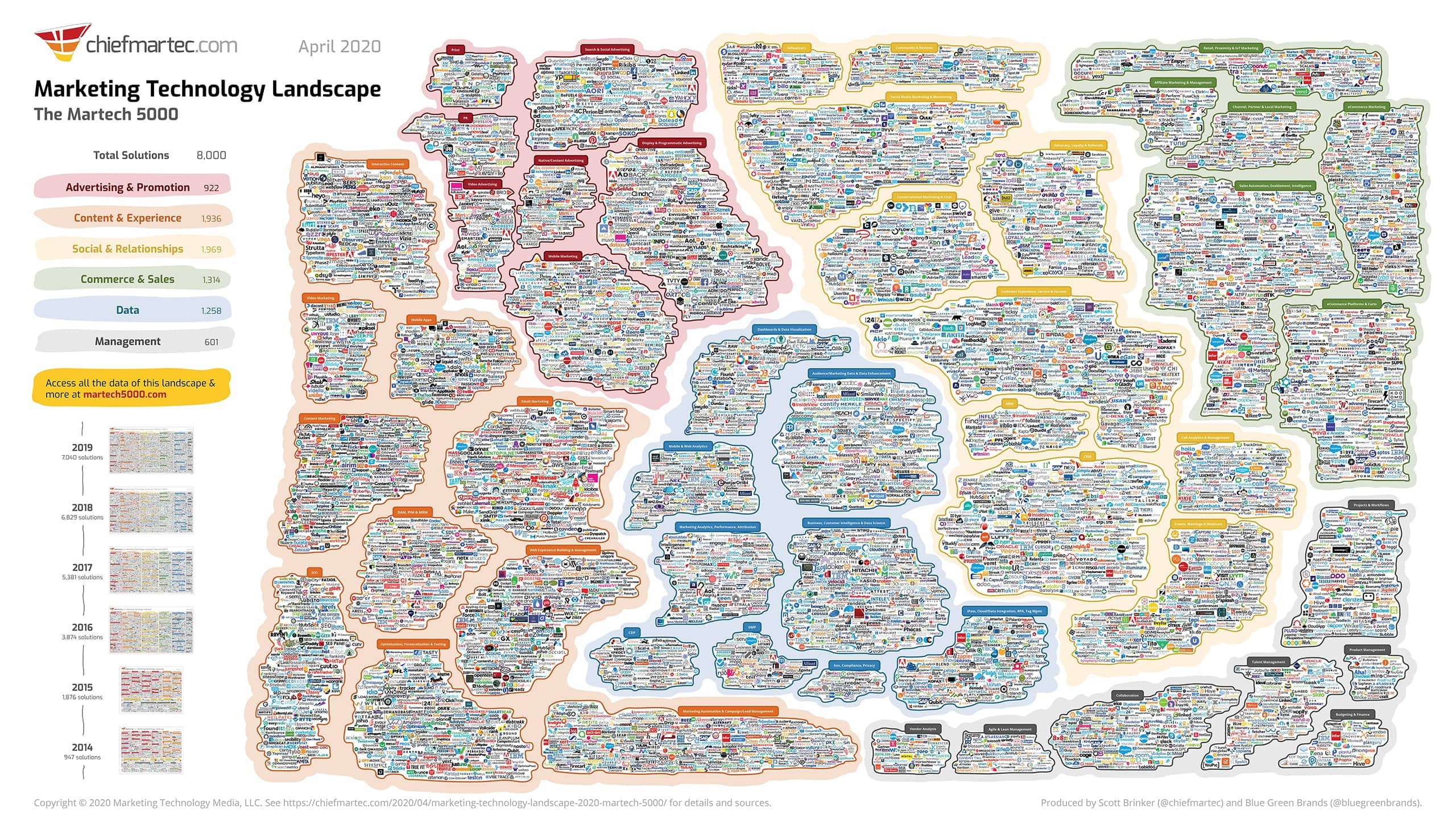
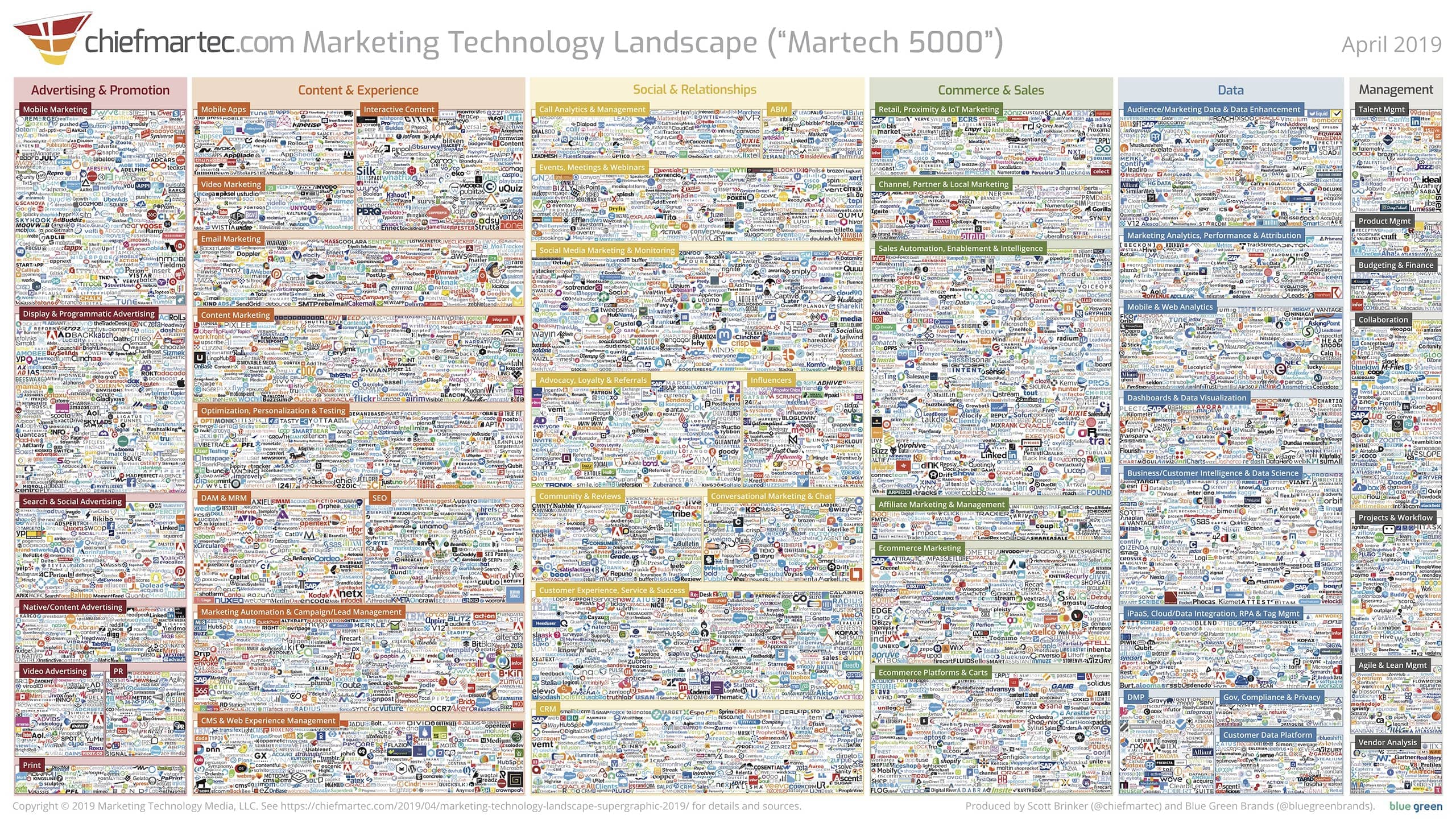
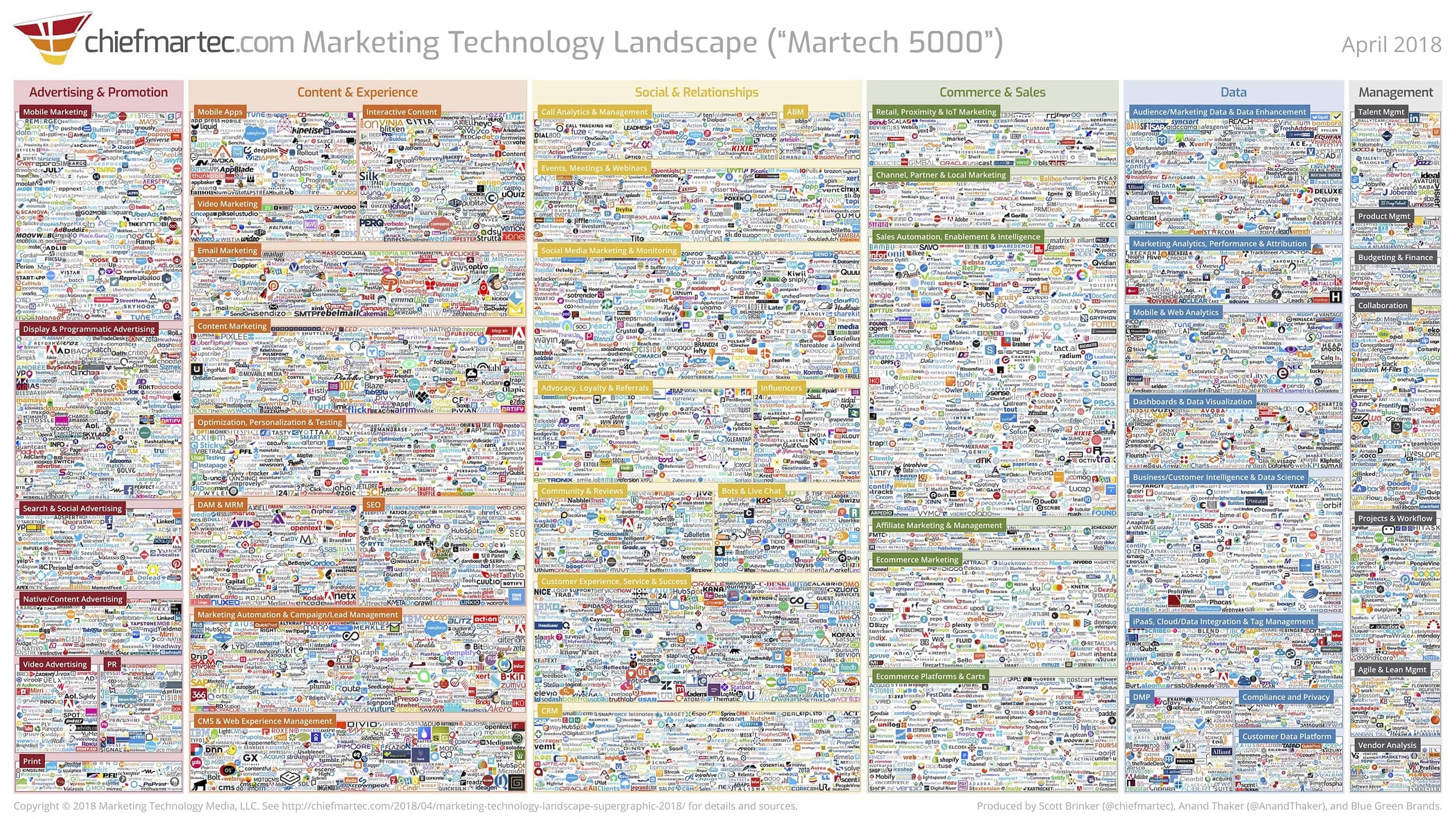
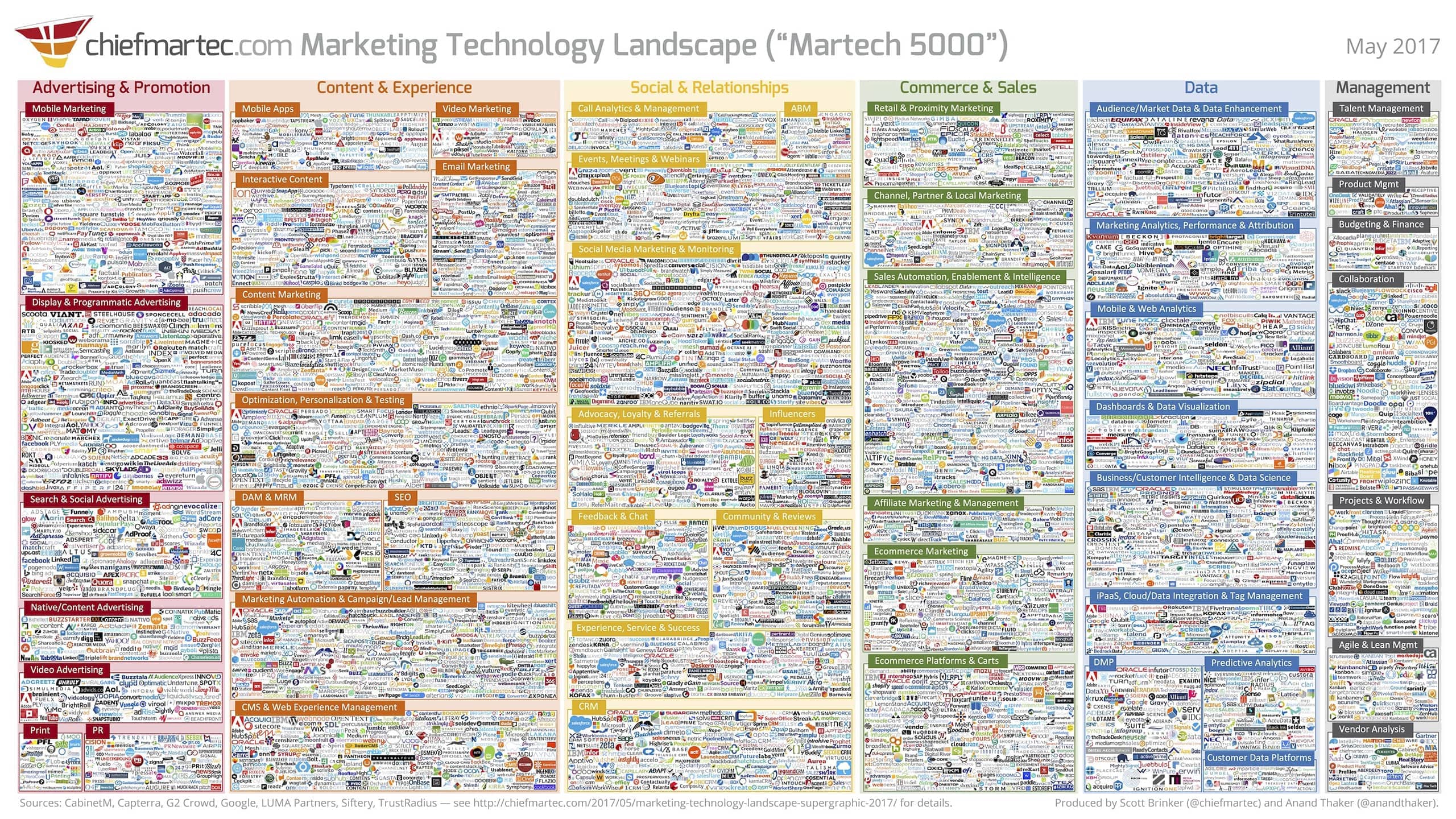
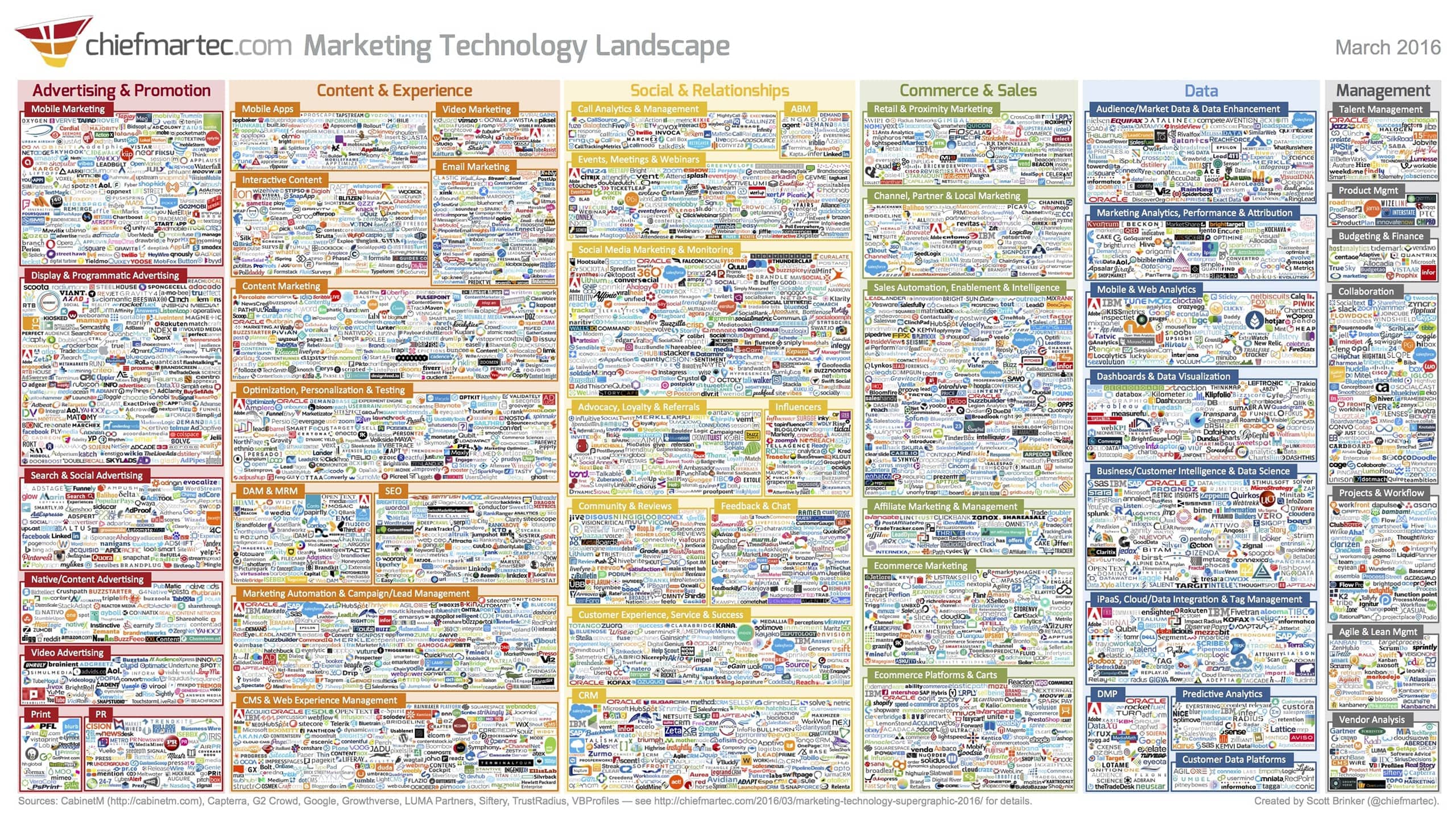
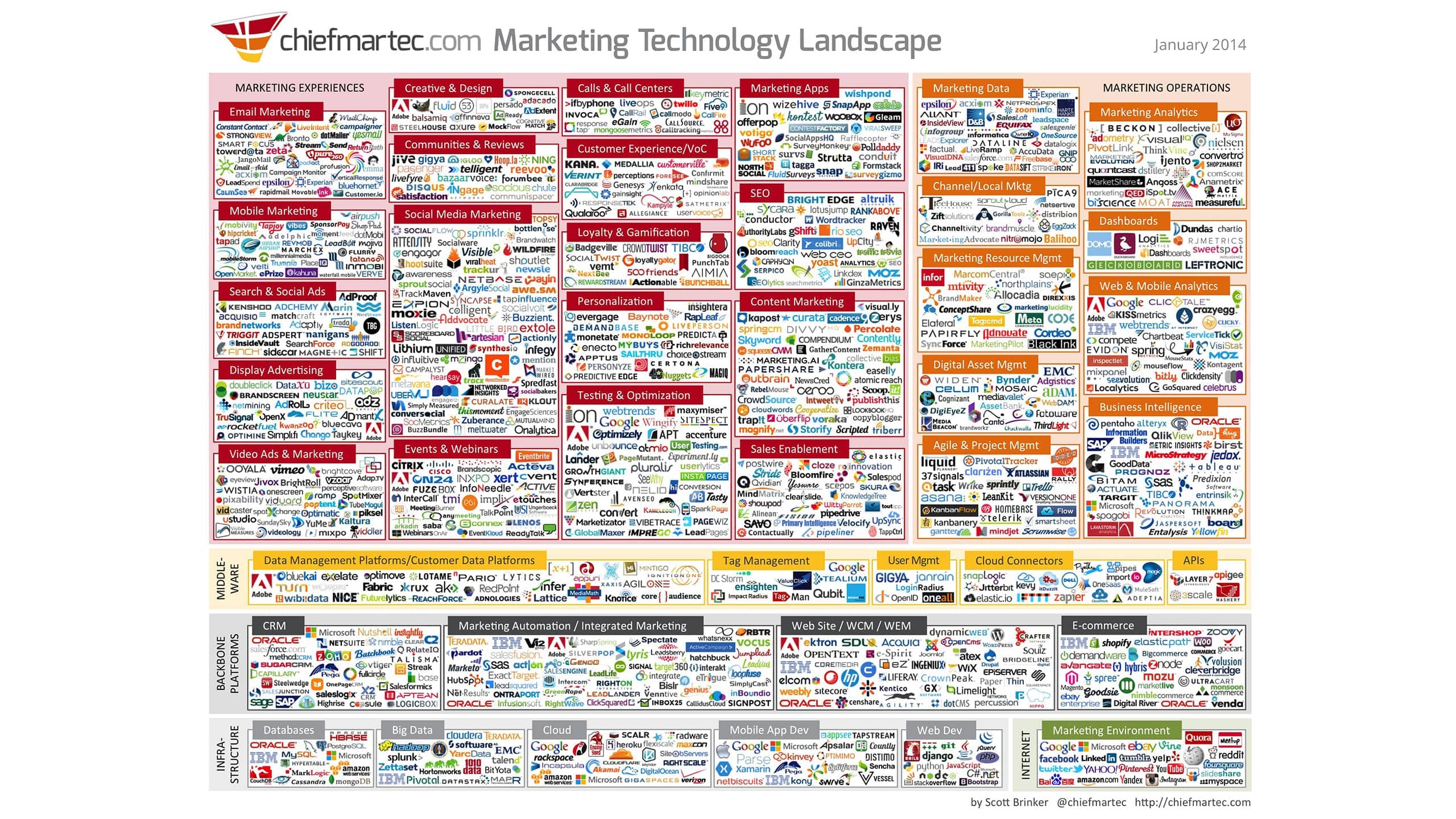
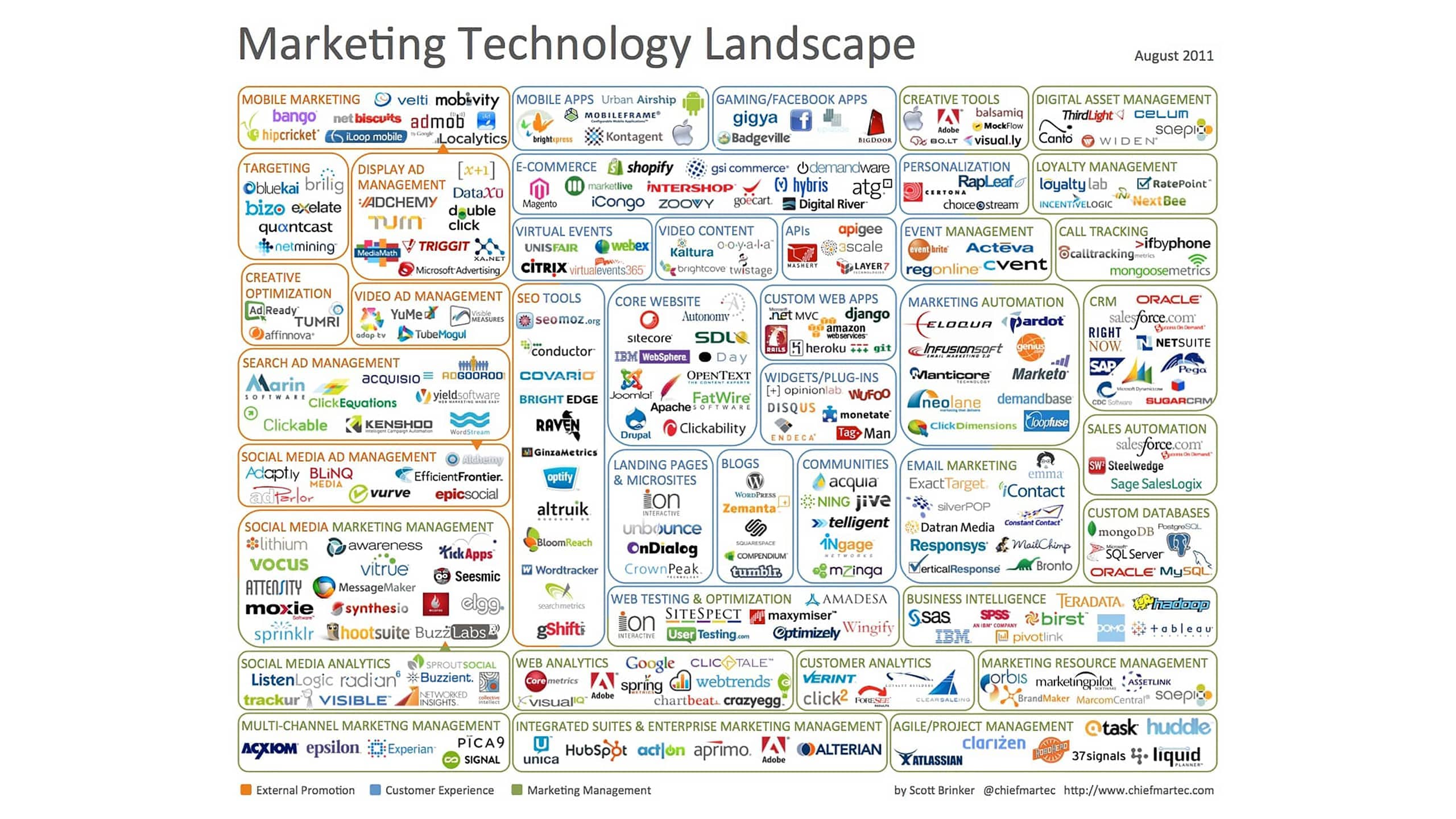
Alongside the large, established players in the MarTech business such as Salesforce, Adobe, Oracle, or HubSpot, hundreds to thousands of new MarTech providers enter the market every year. The American Chief Marketing Technologist blog (chiefmartec.com) has been compiling the software and tool providers in the Marketing Technology Landscape annually since 2011.

The development is—one has to say it: pretty crazy. Especially since mostly American companies are listed; the thriving market of European and Asian solutions is hardly taken into account. #MarTechDarkFigure (learn more about the MarTech Landscape Germany here).

Scott Brinker, head of the chiefmartec.com blog, forecasts further rapid growth and speaks of a MarTech explosion with a tenfold increase(!) by 2030.

The evolution of the marketing technology landscape since 2011. A beautifully confusing overview.

The benefits of MarTech – or: How can the triumphal march of technologies be explained?

Okay, the MarTech landscape is expanding massively; there’s no marketer anymore who doesn’t use at least a few marketing tools. But why is marketing becoming increasingly technological?

MarTech’s strength is this: simplification and creating new potential. It makes marketers’ work significantly easier and faster. Today, anyone can collect, visualize, and analyze website data with just a few clicks and no longer has to run to an IT nerd for it. Even better: a CDP automatically brings customer data together, cleans it up, and interprets it. What used to take weeks now happens on the side.

The benefits go even further. MarTech opens up entirely new horizons beyond simplifying processes. With the help of KI, predictions about purchasing behavior can be made. That simply didn’t exist in the pre-MarTech era. Thanks to social media tools, target groups are found that you previously didn’t even know existed. You can track whether a piece of content was not only clicked, but whether that content ultimately also led to a purchase. And who knows what else is still to come …

All of this has consequences for how we work in marketing today and in the future, and how the marketing team is organized. The priorities are shifting. You can no longer afford not to think technologically. Because then the competition will speed past at hypersonic velocity.

Traditional marketing vs. MarTech marketing: How is marketing changing, and how are we changing?

Modern, MarTech-based marketing has little to do with traditional marketing anymore. The goals have remained the same, but the paths to get there have changed completely.

An example: When you set a new goal for your marketing, what do you ask yourself first:

Matchilla - Matching-Plattform und Marktplatz What creative initiative can I use to achieve the goal?

– or –

Matchilla - Matching-Plattform und Marktplatz What software/technology do I need to achieve the goal?

Granted, it’s not an “either/or”; rather, it’s an “and.” This “and”—keeping creativity and technology in focus at the same time—says a lot about how MarTech is fundamentally changing marketing.

» Technology and creativity are the keys to modern marketing that make the difference. «


Even if we’re not necessarily aware of it, we’re thinking more and more like product managers, combining different technologies for an optimal result. The gap between marketing and IT—ideas here, analytics there—no longer exists.

Scott Brinker (Chair of the MarTech Conference & Editor of chiefmartec.com from the USA) demonstrates this impressively in his TEDx Talk “Everyone Is A Software Developer.”

Is there a difference between MarTech and AdTech?

MarTech and AdTech are closely intertwined, and by now you could consider AdTech a sub-category of MarTech. Nevertheless, there are a few key differences in terms of target audience, data sources, media, and billing structure. The following video illustrates these differences well.

What is a MarTech stack? Organization and challenges in the technology orchestra.

All the individual MarTech solutions you use for your marketing together make up your MarTech stack. If you count in your head how many building blocks your MarTech stack consists of, you’ll probably arrive at a surprisingly large number: 10, 20, 30, or even more individual tools and software?

That means the organization of the MarTech stack is playing an increasingly central role in strategic and operational marketing. All components need to work together, interlock (keyword: software interfaces), and complement each other in a meaningful way. To use a metaphor: the MarTech orchestra should ultimately play a spectacular symphony, and it’s the marketing leadership’s job to act as the conductor. You’ve surely heard “orchestrating marketing” before! 😉

At the same time, the team around the stack has to be formed: Who has access to which tool? What does onboarding for new software look like? Which software skills are new employees sought and hired for? Which MarTech solutions do current and future service providers work with?

Alongside your marketing strategy, a living MarTech stack is the most important guide for your investments.

#TalkMarTechToMe – Interviews with CMOs and marketing experts in MatchZINE

How do I set up a MarTech stack? And beware of the MarTech bubble!

The continuous expansion of marketing technologies means that the selection process for MarTech becomes too complex for a single marketing department. As a result, vendors are usually sought in the immediate network or brought into the mix from team members’ previous jobs. New solutions are rarely considered. Gradually, a MarTech bubble is emerging, pushing the optimal MarTech stack further out of reach.

So how can the process be improved, thereby increasing the chance of finding the right MarTech solutions—both in terms of quality and budget?

To build the ideal MarTech stack, you should consider the following aspects:

Do you work with integrated systems?
A MarTech stack is not a list of tools, but a set of integrated tools that work well together. Look for solutions that have APIs and can be integrated with your CRM, your automation, and your analytics platform.
Do you have a single source of truth?
Many tools have their own analytics, which becomes a problem when combining lots of tools. To maintain data integrity, you should capture your data centrally and use it as a “single source of truth”.
Do you have real-time data available?
One of the major advantages of MarTech is speed. However, you can only fully leverage the potential of data-driven marketing if your stack can process data in real time.
Do you offer omnichannel experiences?
Your stack should enable you to reach a customer at any time and on any channel – with the right content on the right platform. To do that, you need the right tools.
Do you evaluate the ROI?
For ongoing (budget) optimization, your stack must enable you to see the return on investment of each individual measure.

Why is the selection process for MarTech still not technology-driven?

Matchilla now has the answer to exactly these questions! Marketing is increasingly driven by technology, but the search for MarTech solutions is still in its technological infancy or comes from the analog era. This is followed by the familiar lack of transparency – the classic situation when a market grows rapidly.

That’s why our mission is to revolutionize the selection of marketing software with a combination of technology, data from more than 5,000 companies and agencies, as well as personal expertise. In three steps, Matchilla optimizes your entire process centrally on one platform. You save time and costs, minimize resource use in the selection process, and increase your marketing KPIs by ultimately working with the providers that truly fit your marketing needs – whether you’re looking for ABM software, ESG software, an influencer marketing tool, a content marketing agency, or anything else.

MarTech Trends 2025

Crystal clear: Artificial intelligence is currently, without a doubt, the hottest trend in the MarTech space. In content creation processes, AI-powered tools can optimize almost every aspect. Even today, AI can quickly and precisely identify users’ patterns and behaviors and personalize content directly. Lead generation, content distribution, and campaign monitoring are becoming more complex than ever thanks to machine learning.

Closely related to this is the area of AI agents (for matching the best AI agent providers). They have already fundamentally changed the way we search on the internet—and they will continue to do so. This shift set a trend for 2025: companies will optimize their content via SEO strategies for voice search, focusing primarily on the following aspects: long-tail keywords, question-based content, natural language processing, and local SEO optimization. Companies that drive voice search forward will certainly achieve higher rankings. Speaking of language: a seamless and personalized experience that customers have with companies—across various touchpoints—will remain important.

In addition, protecting customer data is extremely important—not least because consumers are demanding control over their own information. If the industry takes this desire seriously, it will be important in 2024 to implement privacy strategies as well as security measures and transparent data collection. This builds trust on the one hand and helps comply with regulations on the other.

Ultimately, in 2025 consumers will also continue to expect that the brands they interact with act in an ethically and morally responsible way and operate sustainably. In this context, software will likely become important that helps companies create corporate sustainability reports (and reports based on other criteria) that comply with the EU standards in force from 2025. Read everything about ESG here.

Tech know-how – the latest MatchZINE articles

Esg-Energie-Mittelstand-Software
MarTech Trends

Energy Management Software: Match Assistant

Ihr möchtet Euer Energiemanagement optimieren und eine digitale Lösung einsetzen? Wir zeigen, worauf es bei der Auswahl der richtigen Software für Euer ankommt und helfen Euch im Auswahlprozess für ein Tool, das perfekt zu Euren individuellen Anforderungen passt.

Software & Tool - Matching
ESG

EmpCo Tool: Check to effectively avoid greenwashing

Ihr seid auf der Suche nach einer QM-Software, um manuelle Prozesse zu optimieren und an Effizienz zu gewinnen? Erhaltet einen Überblick zum Auswahlprozess sowie den Kriterien und profitiert von einem individuellen Matching des richtigen Tools in unserem Qualitätsmanagement-Software-Guide!

Profuktpass-PCF-ESPR-Software vergleichen
ESG

ISO 53001 software: Find the right provider!

Do you want to strategically anchor sustainability and are looking for the right software to integrate ISO 53001 into your processes? We’ll show you what matters when selecting one – from features to helpful tips for your tool search. We’ll also support you with an individual vendor match in our ISO 53001 software guide!

… and this is only the beginning!

#PHEW! That was it—our MarTech journey—and we’ve only shown you a small excerpt of the technology universe. In the months and years to come, a lot of new things will emerge again, and old insights will be turned on their head. But do you think we’ve left out something essential? Or do you still have questions about individual aspects?

We look forward to your feedback on the MarTech guide. Just drop us a line and we’ll be happy to exchange ideas with you.

    Match me if you can!

    Matchilla revolutionizes the selection of new service providers with an efficient combination of data, algorithms and personal expertise. Try out Matchilla for free and without obligation and let matching on our platform become one of your favorite activities.