EUDR Software – The right tools for your EUDR Reporting
Companies are facing major challenges due to a new EU regulation: The EU…
ou start your research on sustainability software highly motivated and quickly realize: The one piece of software that covers all sustainability topics simply doesn’t exist. Sustainability software is rather an umbrella term for technical solutions with a wide variety of functions—some of them overlapping. Many of these tools use abbreviations in their names, which doesn’t exactly make it easier to find your way around.
In this sustainability software guide, we walk you through the numerous acronyms and show you what tools are available for ESG, CSRD, PCF, supply chains, and more—what areas they cover and whether they’re relevant for your company. What’s more, with our Match Assistant you can directly find the right providers that match your company’s needs.
If you already know your way around ESG & co., have heard about our free matching service, and want to start the software selection process based on your criteria right away, here’s a shortcut.
The sustainability management software industry has actually been around for a very long time. However, the real starting signal for one of Europe’s most dynamic markets did not come until 2022: New EU regulations have created completely new requirements for companies. In a short period of time, a dense jungle of laws and directives has emerged—one that many software providers are trying to navigate with their tools. In itself, that’s a good thing. But the sheer number of different tools and software solutions makes the market confusing and difficult to filter.
Fact: With qualified sustainability software, companies gain opportunities to address the new—and sometimes unclear—legal challenges and requirements more efficiently. But how do you find the right solution?
Especially at the beginning, companies ask questions such as:
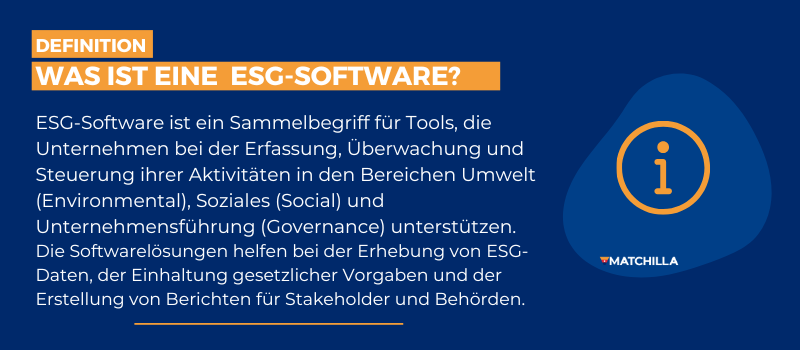
One piece of information upfront: There is no single ESG tool. ESG software is an umbrella term for numerous types of software in the field of sustainability.
These software solutions focus on the areas of environment, social issues, and corporate governance. They help integrate and pursue sustainability and social responsibility goals in the corporate strategy. Among other things, factors such as health, safety, energy and water consumption, and waste generation are recorded and analyzed. At the same time, ESG tools ensure transparency and thus make it possible to implement sustainability management across departments and to fulfill legal obligations.
You can find out more about this in the following article: ESG software.
CSR – Corporate Social Responsibility
CSRD – Corporate Social Responsibility Directive
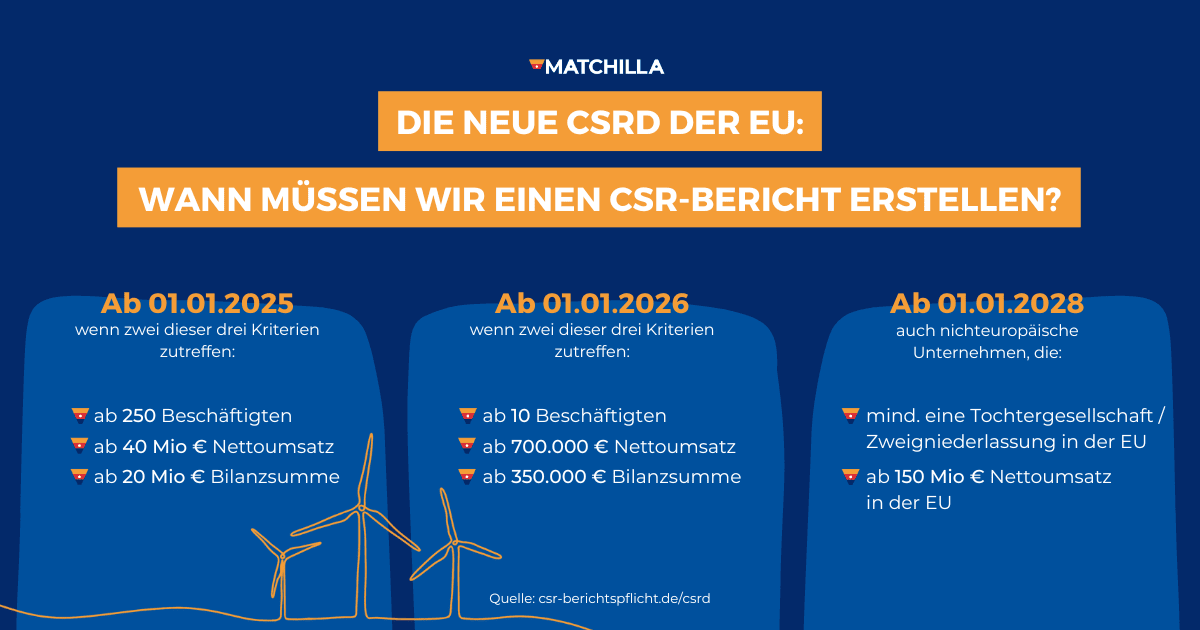
CSRD software supports companies in managing and improving their Corporate Social Responsibility (CSR) through tools for tracking, analyzing and reporting on initiatives such as environmental protection and social responsibility. These solutions help define sustainability targets, monitor progress and communicate CSR performance transparently.
Especially for companies affected by the new EU directives—i.e., the CSRD—such sustainability software helps ensure compliance with the legal requirements in line with the ESRS standards.
If you want to learn more about this, you can find further information here: CSR software and the EU directive.
EHS – Environment, Health & Safety
HSE – Health, Safety & Environment
HSQE – Health, Safety, Quality & Environment
LkSG – Supply Chain Due Diligence Act
CSDDD – Corporate Sustainability Due Diligence Directive
With supply chain software, companies can automate their entire supply chain management. The tool provides support in areas ranging from the manufacturing or sourcing of raw materials, through production, to purchase by customers.
Typical supply chain software includes functions such as order processing, inventory management, and planning and forecasting. This improves efficiency within a company (even across multiple locations). For example, parts management can be made more sustainable, as the software solution provides support with tracking and planning. Potential trouble spots and bottlenecks in the supply chain are also identified early by the software.
The tools are also interesting for companies that want to gain better insight into the costs, value, and reliability of their suppliers.
An important factor considered in the software is, of course, compliance with the current Supply Chain Act. Therefore, the current status of the regulations can be easily tracked with appropriate software.
Stop by here if you want to learn more about software for the Supply Chain Act: Supply Chain Act software.
If you want to find out about the EU’s newly adopted supply chain directive, this article will help you: European supply chain directive CSDDD.
CEMS – Carbon Emission Management Software
EMS – Emission Management Software
Carbon Emission Management software is a reliable partner for companies that want to keep their CO2 emissions under control, reduce their ecological footprint, and comply with legal requirements with confidence.
It records and monitors all emission sources precisely, automatically collects relevant data, and creates meaningful sustainability reports. These automated reports enable transparent and simple communication of the status quo with all stakeholders.
In addition, a CEMS provides targeted support for strategic planning and well-informed decision-making – for more sustainable and future-proof corporate management that is not only interesting for investors, but also leaves a positive impression on potential customers.
Learn more about the topic: CO2 software.
The LCA/life cycle assessment software is the central tool for companies that want to understand the environmental impacts of their products or processes in detail and actively improve them.
It looks at the entire life cycle—from raw materials to disposal—and transparently shows where energy is consumed, emissions are released, or resources are wasted. The software makes it clearly visible in which stages ecological weak points lie and where real potential for greater sustainability is hidden.
Whether for internal optimizations, sustainability reports, or legal requirements—LCA software provides reliable data, creates clarity for everyone involved, and strengthens a company’s sustainability profile—transparent, measurable, and future-oriented.
If you’d like to learn more about the topic, this article will help you: LCA and life cycle assessment software.
CBAM – Carbon Border Adustment Mechanism
CBAM software is a specialized tool that helps companies implement the requirements of the EU Carbon Border Adjustment Mechanism efficiently and in compliance with the law.
The software records the CO2 emissions of imported goods, calculates the associated CO2 footprint based on standardized methods, and prepares the data for mandatory CBAM reporting. It also helps to automatically integrate all relevant information into customs declarations and ensures that complex EU regulatory requirements are met.
This enables transparent, traceable, and time-saving handling of the applicable regulations and reduces the risk of potential sanctions.
You can find a detailed explanation on the topic here: CBAM software.
EUDR – EU Deforestration Regulation
EUDR software is the central tool for companies that want to design their supply chains to be deforestation-free, transparent, and future-proof. It helps them comply with the regulations of the EU Regulation on deforestation-free products, which is mandatory for numerous commodities such as timber, cocoa, coffee, soy, palm oil, rubber, and cattle products.
Suitable software supports companies in providing complete proof of origin, processing geodata, and efficiently implementing risk-based due diligence obligations. It checks whether commodities come from deforestation-free areas, transparently documents every step, and creates all necessary reports for authorities, partners, and investors.
The result: Less bureaucratic effort, maximum data clarity, and a traceable contribution to sustainable supply chain management.
Find out more about the benefits of EUDR software: EUDR reporting tools.
You don’t always need the big, all-in-one sustainability solution that makes sustainability reporting easier—sometimes it’s precisely specialized tools that create real impact and optimize individual areas.
These software solutions help you tackle specific challenges efficiently—whether it’s calculating the emissions footprint of individual products, assessing supplier risks, or documenting legal requirements such as CBAM or EUDR.
So let’s take a look at the most important sustainability tools for specific sub-areas.
PCF – Product Carbon Footprint
Qualified PCF software helps companies precisely analyze the climate impact of individual products across their entire life cycle—from raw material extraction and production through use to disposal or recycling. The software calculates a product’s CO2 footprint based on standardized methods and presents the results transparently.
A traceable and as low as possible Product Carbon Footprint is increasingly becoming a key success factor—whether to meet regulatory requirements such as the ESPR (Ecodesign for Sustainable Products Regulation) or to strengthen one’s market position through transparent sustainability communication, which is becoming ever more relevant for customers and investors.
Here you can find more information on the topic: PCF software.
Waste management software is a digital tool that helps companies systematically record their waste streams, document them in a legally compliant manner, and manage them sustainably.
It centrally stores and analyzes all waste produced in a clear and structured way—from production residues to packaging materials. In doing so, it not only helps ensure that legal requirements are met reliably, but also makes it visible where resources are being wasted and where processes can be optimized.
This gives companies valuable insights into optimization potential—for example in the separation, prevention, or recycling of waste—and enables more efficient collaboration with waste disposal service providers.
If you’d like to learn more about waste management tools, the following article will help: Waste management software.
Energy management software is the central tool for companies that want to actively control their energy consumption, reduce costs, and achieve sustainability goals.
It records and analyzes the use of electricity, gas, heat, or compressed air—often in real time and across multiple locations. This quickly makes it clear where particularly large amounts of energy are being consumed, where potential savings lie, and how optimization measures affect consumption values.
In addition, the software supports the implementation of legal requirements (especially the ISO 50001 standard) and provides meaningful key figures for internal reports or external sustainability reports.
In short: An energy management tool creates transparency, helps with the strategic control of energy flows—and makes energy efficiency measurable and actionable.
Would you like to learn more about the topic? This article will help you: Energy management software.
Sustainability, social responsibility, and good corporate governance have now become concrete requirements that must be reviewed, documented, and managed.
This is exactly where specialized software solutions for the ESG compliance area come in: The tools help companies keep an overview when it comes to complex requirements, reporting obligations, and internal processes in the areas of Environment (Environmental), Social (Social), and Governance. They also play a central role in identifying risks early, keeping an eye on regulatory developments, and efficiently building internal control systems.
The key software solutions include:
A specialised compliance software solution supports companies in systematically complying with legal requirements, regulatory obligations and internal policies. It helps identify relevant obligations, define responsibilities, monitor deadlines and document compliance in a traceable way. The tool covers a wide range of subject areas – from data protection, environmental and labour law to ESG, financial or supply chain requirements.
In other words: compliance software creates transparency, minimises legal risks and facilitates internal as well as external audits. In addition, it automates processes, clearly assigns responsibilities and effectively improves communication between internal company departments.
You can find further information here: Compliance software.
ERM – Enterprise Risk Management
Risk management software is a central tool for companies that want not only to document risks, but also to actively counter them. The tool helps to identify potential threats and uncertainties at an early stage and initiate appropriate countermeasures—whether in the supply chain, with regulatory requirements, in environmental or social areas, or within a company’s own business processes.
The software makes it possible to record and assess risks in a structured way and prioritize them by urgency. Building on this, targeted measures can be planned, responsibilities assigned, and progress monitored continuously.
The best thing about it: All relevant information is centrally consolidated, clearly visualized, and understandable for everyone involved—a real gain for transparency, efficiency, and internal collaboration.
Learn more about the topic here: Risk management software.
The different types of software solutions for sustainability help with implementing legal requirements and make it easier to track environmental and climate goals. But health, safety, and social issues are also important pillars of many sustainability tools. Actively addressing the ecological footprint also ensures a better corporate image, provided that the sustainability targets are demonstrably implemented.
Which sustainability software solution ultimately makes sense depends on the industry and individual requirements. When used effectively, the various tools enable convenient compliance with all targets and, through continuous monitoring, ensure better profitability.
Approach for selecting sustainability software
To do: Check which regulations affect you and when. As a rule, you start with the CSRD, but additional guidelines may also be added. If, at this point, the CSRD is your only reporting challenge, you can skip the next steps directly.
Why it matters: ESG software providers are at different stages in their development and may not include the modules you need in their product strategy.
ToDo: With the roadmap, you have identified the deadlines and topics. Now create a list of around 10 criteria that are particularly important to you on the one hand and absolutely required on the other.
Why it matters: You need to identify from providers’ offerings whether module combinations such as CSRD and PCF or CBAM and EUDR can be implemented with one provider, or whether you need multiple providers. You will quickly notice that there are real showstoppers with favored software providers.
ToDo: Start screening and researching the market to create an initial long list. For a more resource-efficient process, it’s best to use Matchilla’s matching service right away and save yourself this effort.
Why it matters: You will quickly realize that there is still no provider that already covers all regulations with modules and offers an end-to-end solution. However, in the respective product roadmaps you can already see a trend as to whether, for example, the focus is on an industry or a topic – a common difference in focus is LkSG vs. PCF.
ToDo: Find out which technical tools and digital solutions can be used to implement the process steps in reporting in order to capture data efficiently, analyze it, and create reports based on it.
Why it matters: The CSRD software used in your organization will be the accelerator of your reporting processes and, in the longer term, will gradually replace potential consulting services. Here, you should not commit to a predefined tech stack.
A tip at this point: Choose an ESG tool provider with a forward-looking approach. Even if a module is missing to cover all areas of work, the provider can recommend a partner and create interfaces between the tools.
It is absolutely right to think in terms of an overall structure. But your goal should by no means be to find the all-encompassing ESG software provider right now that offers a solution for every guideline. You will quickly become frustrated and lose valuable time. Therefore, build your search for the right provider step by step and set clear priorities.
Finding the right sustainability software is often a lengthy and tedious task that takes a lot of time. To make the effort easier, you can now benefit from our matching system!
As you can see from this summary, at Matchilla we take an in-depth look at the different types of sustainability software and continuously screen the vendor market with over 160 software providers in German-speaking countries. We provide you with our market research and our experience from over 700 matchings (for mid-sized companies and corporations) as a service to help you select the most relevant providers for you.
But how does it work? You invest just a few minutes filling out our Match Assistant and, after your matching request, you’ll be presented with three sustainability software providers as recommendations – selected precisely according to your individual needs. Get started right away with our Match Assistant and match conveniently with the right providers instead of searching for them in a time-consuming and tedious way.
The best part: Our matching process is non-binding, free of charge for you, and anonymous to the providers.
Want to know which sustainability solution best fits your requirements? Fill out the Match Assistant now! 👇

Finding suitable ESG service providers is easy and super fast via Matchilla. Getting in touch, formulating specifications, and after just a few days the results were there. This way we got information on providers we hadn’t heard of before. Real added value.

I was convinced by Matchilla’s short, clear paths: our specific need is understood immediately, analyzed perfectly, and matched with the right providers in a short time. Matchilla’s platform works quickly, uncomplicatedly, and guides you precisely through the provider selection process.

Matchilla’s approach is brilliant: I no longer have to painstakingly research consulting firms and software providers and fight my way through countless comparison portals—the right providers, so to speak, come to me—with just a few minutes of effort. The matching process saves us many resources.
Ulli Theves is Head of ESG Matchings at Matchilla and an expert in technical solutions in the field of sustainability. In the MatchZINE, he shares his expertise and regularly publishes current news and useful information on the topic of ESG.
Companies are facing major challenges due to a new EU regulation: The EU…
CSRD, EUDR, CBAM, ESPR, CSDDD & Co. – numerous obligations for companies around…
Do you want to optimize processes in the field of sustainability and keep…

Match me if you can!