HSE & HSEQ software – the right tools and systems for you
Are you looking for HSE software? Then you’re not alone. Numerous companies are…

ccupational health and safety is more in focus in companies than ever before: new legal requirements, increasingly complex operating structures, and a growing awareness of holistic risk management are making traditional Excel spreadsheets and siloed solutions ever more cumbersome, confusing, and time-consuming. A qualified occupational safety software solution addresses this precisely, creating a central platform to standardize processes, efficiently meet documentation requirements, and sustainably improve workplace safety.
In this article, you’ll get a structured overview of the market for occupational health and safety software, helpful decision criteria, and practical tips for selecting the right tool.
We also share with you our know-how from over 700 GRC matchings for mid-sized companies and large enterprises in an individual vendor comparison. This way, you can quickly find the most relevant occupational health and safety tool that fits your company!
Would you like to dive deeper into the topic of occupational health and safety and workplace safety? Then you’ll find all the relevant information here. Alternatively, you can start our free matching right away to identify exactly the ASiG providers that fit your individual requirements:
The market for occupational health and safety and EHS software has grown significantly in recent years and has therefore become increasingly confusing. Software listing portals now feature several hundred systems for safety management, risk assessments, training instructions, or audit processes. Navigating between numerous specialized point solutions and large platforms and filtering out the right tool is therefore difficult and time-consuming.
Although numerous articles with titles such as “The 10 best occupational safety tools” or “Top occupational safety software compared” promise guidance, they generally do not help with making a truly tailored selection. The reason: they reflect neither your company’s individual requirements nor your specific priorities in occupational health and safety.
To make the market more transparent and to get an initial overview, we roughly divide the software providers for our matching process into the following three categories:
Compact solutions for small businesses
This category includes occupational safety software that focuses specifically on the basic legal obligations. The focus is on functions such as risk assessments, training instructions, documentation of measures, and simple evaluations. The solutions are designed to be quickly deployable even without in-depth expertise and to reliably cover minimum legal requirements.
Mid-market solutions with a broad range of features
In the mid-market segment, you will find occupational safety software solutions that go beyond pure basic functions and provide more comprehensive support for operational and organizational processes. In addition to risk assessments and training instructions, training management, audits, task and action management, as well as more granular reporting are often offered.
Enterprise platforms for corporations and complex structures
At the top end of the market are comprehensive HSE management platforms and occupational safety platforms that understand occupational safety as part of an integrated governance, risk & compliance approach. These solutions are designed to centrally manage complex, international organizations with high regulatory requirements.
What does this categorization mean for you? Segmenting the market helps to narrow down the large number of providers more precisely and to approach the selection in a more structured way. Instead of being guided by confusing tool lists or generic rankings, you can clarify in the first step which segment you should be looking in most sensibly.
At the heart of this is always the question of what role occupational health and safety software should take on in your company in the long term: Is it about digitally mapping individual processes (such as risk assessments or trainings)? Then a compact solution can quickly and cost-effectively provide added value. If, on the other hand, occupational health and safety is to be set up more broadly and linked with existing systems, it is worth taking a look at mid-market solutions with modular expandability.
It is also important to realistically assess your internal conditions and resources. Because budget, IT infrastructure, available capacities, and future scaling plans have a major influence on which solution is viable and sensible for your organization in the long term.
The good news: You are currently on the right page to effectively get closer to the software providers that match your company’s individual needs.
Now that you’ve gained an overview of the provider landscape in the German-speaking region, the next key question arises: Which functions should occupational health and safety software actually cover to optimally support your requirements?
Because whether you choose a compact entry-level solution, a modular mid-sized business platform, or a comprehensive enterprise system, what matters in the end is that the software maps the right processes, meets legal requirements, and can be seamlessly integrated into your existing work environment and workflows.
Regardless of company size or industry, a set of core functions has become established that is included in most occupational safety software solutions. These include:
Risk assessments
The structured creation and management of risk assessments forms the foundation of digital occupational health and safety processes. Using templates, checklists, and automated assessment steps, responsible parties systematically identify potential sources of danger, evaluate risks, and derive appropriate protective measures. All changes are stored in a traceable manner and documented in an audit-proof way.
A metal fabrication company commissions a new CNC milling machine. The software automatically creates a new risk assessment. The safety officer records the work areas, documents possible hazards such as sharp edges, noise, or rotating parts, and assesses their risk based on likelihood of occurrence and severity. Protective measures such as hearing protection, guards, or emergency stop switches are stored directly. When legislation changes, the assessment is automatically flagged for update so that no outdated documents remain in circulation.
Document management
Whether operating instructions, safety protocols or training certificates: occupational safety is documentation-intensive. Qualified software solutions consolidate all safety-relevant documents in a central repository. This makes it easy to manage documents, archive them by version, and distribute them to relevant employees in a targeted manner.
In a large construction company, different versions of operating instructions had previously been circulating via email or in paper form. By introducing occupational safety software, all documents are maintained centrally. As soon as a safety document is updated, the system automatically informs all affected locations. Employees only need to confirm the new version digitally. During an inspection by the employers’ liability insurance association, the company can therefore prove at the push of a button who received and read which version, and when.
Instruction and training management
Mandatory briefings and safety training courses are legally required and must be documented on a regular basis. Occupational safety software supports the planning, implementation and documentation of these training courses digitally. Learning progress, deadlines and participation can be viewed centrally. Automated reminders also ensure that no training is forgotten.
A logistics company with multiple locations integrates its briefings into the occupational safety tool. New employees automatically receive the relevant safety training online after the contract is created. Supervisors can see at any time who has completed their briefing and who is still pending. When a training course expires, a new invitation is automatically sent. During audits, the company can export a complete proof of training at any time, including attendance history and electronic signatures.
Nonconformity and corrective action management
With digital nonconformity management functions, deviations or safety defects can be recorded directly on site – including photos, location details, and a description. Responsibilities, deadlines, and measures are assigned and tracked directly in the platform. Automatic notifications ensure that no item is missed or skipped.
During a routine walkaround on the company premises, a safety officer notices a damaged railing on a walkway platform. Using the mobile app, the defect is documented in just a few seconds: take a photo, mark the location, add a description, set a deadline and assign a responsible person. The maintenance department receives an immediate notification. If the deadline is exceeded, the system automatically sends a message to the department head.
Risk assessment
In addition to recording hazards, a qualified occupational safety software supports the structured assessment and prioritization of risks. The probability of occurrence, severity, and existing protective measures can be recorded. This results in traceable risk profiles that serve as a basis for decisions and make planning measures easier.
In a chemical plant, the handling of flammable solvents is re-evaluated. Using the tool, the relevant work areas are selected, the risk of ignition is assessed, and the possible consequences are described. Based on predefined assessment matrices, the system creates a risk profile and indicates that additional ventilation measures are required. After implementation, the risk is re-assessed and documented.
Inspection and maintenance management
Recurring inspections and maintenance are essential to comply with safety standards. An occupational safety tool supports scheduling, automatically reminds responsible persons of upcoming inspections, and digitally archives maintenance logs.
In a manufacturing plant, ladders, fall protection systems and lifting equipment must be inspected regularly. The software maintains a central directory of all equipment subject to mandatory inspection, assigns responsibilities and generates automatic reminders before deadlines expire. Once the inspection has been completed, the reports are uploaded and archived directly. This means all evidence is available at any time for internal or external audits with just a few clicks.
Report and record creation
Whether internal analyses, audits or inspections by authorities – reports often need to be available quickly and in full. Modern software solutions automatically generate reports, statistics and trend analyses. At the same time, dashboards provide a structured overview at a glance of where action is needed.
An energy supplier is preparing for an audit by the employers’ liability insurance association (Berufsgenossenschaft). With just a few steps, the HSE department creates a report on all risk assessments, training sessions, inspections and open actions from the past twelve months. The auditor receives complete, traceable documentation without the need to manually compile data or risk careless mistakes creeping in.
Hazardous substances management
When handling hazardous substances, the software supports the creation and maintenance of hazardous substances registers, safety data sheets and protective measures. This ensures that all legal requirements are met and that employees have access to relevant information at all times.
A paint shop maintains all chemicals used centrally in the system. New substances are stored directly with the associated safety data sheets and storage instructions. On-site employees access all relevant safety information easily via a tablet. If the composition changes, the system is updated automatically and informs all relevant departments.
Legal certainty and compliance
A key objective of any occupational safety software is to make it easier to comply with legal requirements. Standardized processes, clear responsibilities, and automatic documentation reduce liability risks and ensure documentation obligations are met efficiently.
The functions presented clearly show that occupational safety software is far more than a digital filing system. It maps key occupational health and safety processes, standardizes workflows, and creates a robust foundation for legally compliant documentation and continuous improvement.
It quickly becomes clear: Not every business needs the full range of functions, but it definitely needs a solution that supports the processes relevant to the company in a tailored way.
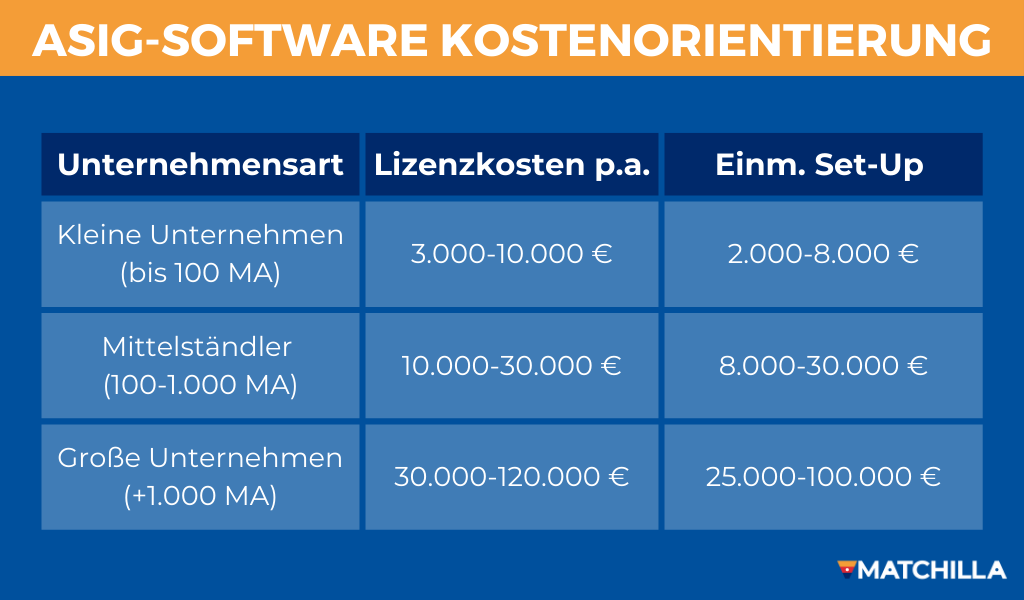
Implementing occupational safety software is a strategic investment in which the economic aspect must also be examined more closely. The fact is: The actual costs of an occupational safety tool depend heavily on company size, the scope of functions, and the chosen provider segment, which means that no flat-rate, universally applicable price can be determined.
Typical cost factors that cause costs to vary include, among others:
Number of software users
Company size
Scope of functions
Additional modules
Company organizational structure
The following table provides guidance on license costs as well as the initial implementation effort (including internal project costs):
At first glance, the investment seems high, as no revenue increases and no concrete potential benefits are visible.
Let’s therefore use an exemplary rough ROI calculation as a guide:
| Ausgangssituation / Unternehmensprofil | |
|---|---|
| Mitarbeitende | 300 |
| Branche | Produzierendes Gewerbe / Industrie |
| Aktueller Stand | Excel-Listen, Papierdokumentation, verteilte Daten, hoher manueller Aufwand |
| Risikoexposition | Erhöht (Unfälle, unvollständige Dokumentation, Audit-Risiken, Bußgelder) |
| Ziele | Rechtssicherheit, transparente Dokumentation, Zeitersparnis, Reduktion von Arbeitsunfällen |
| Investition in Arbeitssicherheits-Software (einmalig) | |
| Implementierung & Einrichtung | 8.000 € |
| Datenmigration & Strukturaufbau | 4.000 € |
| Schulungen & Onboarding | 6.000 € |
| Gesamtkosten einmalig | 18.000 € |
| Jährliche Kosten (wiederkehrend) | |
| Lizenzkosten | 12.000 € |
| Wartung, Updates & Support | 3.000 € |
| Interne Aufwände (Administration) | 5.000 € |
| Gesamtkosten jährlich | 20.000 € |
| Einsparungen & Nutzen pro Jahr | |
| Reduzierter Administrationsaufwand | 10.000 € |
| Weniger externe Beratung & Audits | 5.000 € |
| Effizientere Auditvorbereitung | 3.000 € |
| Vermeidung von Bußgeldern & Rechtsfolgen | 4.000 € |
| Produktivitätsgewinne durch weniger Ausfälle | 6.000 € |
| Gesamtnutzen pro Jahr | 28.000 € |
| ROI & Wirtschaftlichkeit | |
| Investition Jahr 1 | 38.000 € (18.000 € einmalig + 20.000 € jährlich) |
| Investition ab Jahr 2 | 20.000 € / Jahr |
| Einsparungen | 28.000 € / Jahr |
| Break-even | nach ca. 16–18 Monaten |
| Netto-Ersparnis ab Jahr 2 | 8.000 € / Jahr |
In this example, the investment pays off after around 2 years. After that, the software generates measurable financial added value.
However, in addition to these savings, indirect benefit factors also play an important role: better preparation for audits, lower liability risks, strengthening the employer brand, and a sustainable improvement in the safety culture. These factors are harder to express in euros, but can be decisive, for example, in certifications, tenders, or crisis prevention.
Our recommendation: In our Work Safety Match Assistant, in the “Briefing” section, add the note “Previous price indication desired”. In most cases, providers can then offer a non-binding cost estimate.
The market for occupational safety software has grown significantly in recent years. Feature sets, specializations, and provider profiles sometimes differ considerably. Accordingly, selecting the solution that truly fits your requirements is challenging.
This is exactly where Matchilla comes in: We know the market for occupational safety and HSE software in detail and support you in a structured provider selection process with sound software and process expertise.
Our matching process enables you to identify the occupational safety software that fits your company in terms of content, technology, and organization. The basis for this is our continuously maintained provider database as well as the experience from over 700 successfully completed matchings for medium-sized companies and corporations.
The best part: This individual ASiG software comparison is non-binding, free of charge, and anonymous vis-à-vis the providers for you.
Would you like to find out which occupational safety software best supports you in optimizing your occupational health and safety processes? Then take a few minutes and fill out our ASiG Match Assistant or register on the Matchilla platform!
We look forward to matching with you!
Providers in the matching: 29
Problems with the display? Open the Match Assistant in a new window here

To choose the right service provider and software solution, Matchilla offered us perfect support—from describing the challenges and the initial suggestions through to the final decision. We were particularly impressed by how quickly they understood our specific situation!

We were very impressed by the wide variety of partners – and by how they were selected to match our specific requirements for our matchboard. The methodology of the matching process, as well as Matchilla’s quick response to a request for individual customization, led us to an excellent result.

With Matchilla, we can easily open ourselves up to input from new service providers that were previously outside our radar. Our search criteria are matched against a database, but the final suggestions are in the hands of the Matchilla team. The result: High quality and strong service!
The software market in the HSE sector is non-transparent. Listing portals or directories usually only provide a long list that doesn’t really help when it comes to narrowing down the tools that best fit you.
We have already successfully carried out the structured matching process for occupational safety software that you go through with us for numerous companies (SMEs and large corporations), and therefore know virtually every possible constellation when searching for tool providers. We screen the entire HSE software market weekly, and even the individual ASiG areas such as training/instructions, risk assessments, fire protection, etc.
With this market overview as a data foundation, combined with our personal expertise, you gain an immense knowledge advantage that not only saves you the cumbersome research work, but also leads you to the right provider in a structured process via the Matchilla platform.
Matchilla’s service is free of charge, non-binding, and anonymized vis-à-vis the providers. The individual evaluation to select the best software for you, as well as the provision of extensive background information, is financed through the providers’ platform fees.
In general, we are not in any paid contractual relationship with you; the selection is of course up to you, as is ending the matching process at any time.
The Matchilla platform can even be used for an official tender for occupational safety software. In addition to the available information about the providers on the Matchboard, you collect the corresponding offers directly on the Offerboard. Using the Invite function, you can then share all information not only with the plant manager or purchasing, but optionally with all process participants in the company.
With this approach, Matchilla creates an individual provider competition for your specific matching request, making prices more comparable and negotiable for you. That will make procurement, the boss, and your own budget happy!
Our selection process is based on an efficient interaction of data, algorithms, and a solid portion of personal expertise. No Matchboard is released without one of our experts adding their own input.
Think of Matchilla as a neutral sparring partner in this software selection process. We want your company to continue using Matchilla’s services for many more searches for service providers in the future. That’s why we have a strong interest in ensuring that you not only access an excellent procurement process, but also ALWAYS find the best possible providers through us.
Simply start by filling out the Match Assistant for occupational safety software. This gives us an initial insight into your requirements. If you already have a catalog of criteria, you can also upload it directly on the Matchilla platform. We will contact you personally if further specifications are needed. The more detailed the selection criteria we have, the more precise the matching will be with the tool providers most relevant to you.
René Kühn is the founder and managing director at Matchilla. With experience from over 700 matchings for mid-sized companies and corporations, he and his team were able to build one of the best market overviews for software providers.
Are you looking for HSE software? Then you’re not alone. Numerous companies are…
Are you looking for QM software to optimize manual processes and gain efficiency?…
Are you looking for a compliance management system that optimizes your processes? We’ll…