Compliance software – matching the best systems and tools

Do you want to digitize your compliance management in a structured way and are looking for the right tool? Our compliance software guide shows you what matters when choosing software and supports you with tailored vendor matching.

C

ompliance has become significantly more complex in recent years. New requirements in the ESG environment as well as regulatory developments in the areas of IT and cybersecurity are continuously expanding the range of responsibilities. Accordingly, the range of software solutions is diverse, making the selection of a suitable tool increasingly challenging.

In this article, you will receive a comprehensive guide to selecting compliance software with tips and practical insights so that you can get started with the right tool and build excellent data structures and processes.

In addition, we share with you our know-how from more than 700 compliance matchings for SMEs and corporations as part of an individual software selection, in which you can efficiently gain an overview of the providers most relevant to you.

Matchilla - die drei Schritte im Matching

Which compliance software is right for you?

Would you like to dive deeper into the topic of compliance? Then you’ll find all the relevant information here. Alternatively, you can start our free matching right away to identify exactly the compliance software providers that fit your individual requirements:

👉 Go directly to compliance matching

Compliance software 2026

Compliance Software 2026

Compliance software: Why digital tools are becoming indispensable

Compliance has evolved from a purely mandatory task into a company-wide management function. New regulatory requirements in the ESG, IT and governance environment increase the coordination effort between departments and require consistent documentation of policies, responsibilities and measures. At the same time, customers, investors and business partners increasingly expect transparency in how risks and corporate responsibility are handled. Being compliant is therefore no longer solely a legal necessity, but a decisive factor for trust and competitiveness.

The challenge lies less in any single set of rules than in the large number of parallel requirements (especially ISO standards). Without structured system support, this often leads to fragmented responsibilities, inconsistent documentation and a high level of manual coordination effort. Risks are identified too late, measures are difficult to track, and audit processes require extensive preparation.

Zitat: Compliance-Software

Under these conditions, manual solutions quickly reach their limits. Decentrally maintained spreadsheets, isolated document repositories or inconsistent processes make traceability more difficult and increase coordination effort in day-to-day operations. Risks remain undiscovered for longer, responsibilities are unclear and evidence can only be compiled with considerable effort in the event of an audit.

Qualified compliance software provides the structural foundation to systematically implement internal objectives and applicable requirements. This enables companies to embed compliance not only from a regulatory standpoint, but also organizationally, while simultaneously strengthening predictability for stakeholders.

Before selecting a suitable compliance tool, it is crucial to clearly define your own objectives and narrow down which standards and requirements affect your company. Depending on the industry and risk profile, requirements differ significantly – and this has an impact on the appropriate software strategy. 

Market overview: compliance software providers in the DACH region

The market for compliance software is difficult to navigate due to a multitude of specialized point solutions. International software directories now list several hundred systems—ranging from topic-specific applications (e.g., in the area of whistleblowing) to comprehensive all-in-one solutions or GRC suites.

General tool lists or rankings provide an initial orientation, but they rarely take into account a company’s individual requirements, objectives, and risk profiles. For a well-founded pre-selection, it therefore makes sense to first structure the provider landscape along key software categories.

Compliance Software Definition

For the matchings and the selection process on our platform, we therefore divide the compliance tools into the following categories:

Matchilla - Auflistung Compliance Funktionen GRC suites (Governance, Risk, Compliance)
These are the big all-rounders with comprehensive platforms that combine functions for compliance, risk management, data protection, supply chain, whistleblowing system and much more in one system—often modular in design, extremely flexible, but frequently also (very) complex.

Matchilla - Auflistung Compliance Specialised solutions for compliance topics
There are a large number of tools with solutions for specific compliance topics. On the one hand for data protection, cybersecurity, ESG, HSE & Co., and on the other hand for compliance specialist areas such as finance, production or HR. In some cases, the requirements for individual topics are so extensive that individual software is designed specifically for individual ISO standards and laws in order to meet them as well as possible.

Matchilla - Auflistung Compliance Industry solutions with compliance modules
Here, ERP or quality management software solutions should be mentioned that have integrated compliance modules for specific industries and sectors – including environmental requirements, certifications or specific occupational safety measures. Compliance is more of an add-on here, not the core function. A different approach, but certainly the right path for some companies.

For the selection process, this segmentation primarily means one thing: The right software solution largely depends on which compliance topics are prioritized in the company and how broadly the system is intended to be set up in the long term. While specialized tools are often suitable for individual use cases, company-wide compliance management requires a consolidated view of all relevant subject areas.

Good news: You are currently on the right page to effectively approach the most suitable software providers who best meet your company’s needs!

Excursus: Compliance vs. GRC – What’s the difference?

In the market for corporate governance and regulatory software, you quickly come across two terms: compliance software and GRC software. While they are often mentioned in the same breath, they are not on the same level. GRC is the overarching framework; compliance is a component of it.

Compliance software generally focuses on the systematic adherence to external laws and internal policies. Core functions include policy management, training and attestation records, whistleblowing systems, case management, documentation of violations, and audit-proof reporting. The goal is to manage compliance in a traceable way and reduce liability risks.

GRC software takes a broader approach. The term stands for “Governance, Risk & Compliance” and describes an integrated management model that connects corporate governance, risk management, and compliance. Accordingly, in addition to classic compliance functions, GRC platforms often include risk inventories, internal control systems (ICS), audit management, control testing, and strategic reporting structures. Compliance is not an isolated module here, but part of a comprehensive management and control system.

How do compliance and GRC differ?

Compliance focuses on adhering to legal and internal requirements—including documentation, training, and case management.

GRC ...

... is the overarching approach and combines governance, risk management, and compliance in an integrated platform for holistic corporate management.

For many mid-sized companies, a specialized compliance solution is a sensible entry point—especially when specific regulatory requirements are the main focus. The scope of functionality remains clearly defined, and implementation is organizationally manageable.

However, anyone who, in the longer term, wants to link risk and control processes more closely with compliance should at least take holistic GRC structures into consideration. Since GRC forms the overarching framework, compliance can be strategically embedded in such systems rather than managed in isolation. What matters, therefore, is not the abbreviation, but the question of how integrated the company’s governance and control processes should be set up going forward.

What functions does a qualified compliance software have?

If you’re looking into implementing a compliance system for the first time, or are currently using older software, you’ll be amazed at how efficiently today’s tools can support you. Of course, you can still do everything manually with Excel & Co. But that is usually cumbersome and, due to the lack of predefined templates, involves a lot of effort. In addition, the requirements of compliance tasks continue to increase, which means that manual execution becomes a source of errors.

A professional software solution provides a remedy here – it links key elements, ensures transparency, and saves valuable resources.

Depending on its complexity, implementing a compliance software solution can be done step by step and gradually integrated into existing systems—whether modularly via a comprehensive GRC suite or through specialized standalone solutions that connect seamlessly with one another via interfaces.

But what does compliance software actually do, and how does it make work easier? Here are the most important functions:

Matchilla - Auflistung Compliance Funktionen Legal register & legal monitoring
As a company, you are subject to a wide range of laws, standards, and regulations that are regularly updated and revised. Compliance software ensures that all relevant legal requirements are automatically captured, updated, and documented in a central legal register tailored to your needs. The software monitors laws, notifies compliance managers of changes, and helps with meeting new requirements.

A mid-sized mechanical engineering company in Baden-Württemberg manufactures for the automotive industry. Due to a change in the Product Safety Act (ProdSG), the company must update certain CE markings. The compliance software detects this automatically, identifies the affected product groups, and informs the production management. They adjust the technical documentation—without having to manually check the legal situation.

Matchilla - Auflistung Compliance-Tool Einsatz Flexible risk management
Risk analysis with integrated risk management is a central component of compliance software. With this function, companies not only identify risks, but also assess them, implement internal controls, and take appropriate measures to reduce risks in a timely manner. A compliance tool should include flexible risk management that continuously monitors and reports on various risk factors—such as legal changes, internal processes, and external market conditions.

A food manufacturer in Salzburg also supplies its products to Germany. Due to a new regulation on allergen labeling, the risk of warnings increases. The software classifies this as moderately high, generates a recommendation for action to review the packaging, and creates a task list for the QM team – with deadline and responsibility.

Matchilla - Auflistung Compliance Funktionen Auflistung Database for document management
Due to regulations – such as the extensive ESG requirements – companies must manage a wide range of policies, certificates, training records, audit reports, and legal requirements as part of their compliance efforts. A compliance software should therefore offer the ability to manage these documents securely, transparently, and clearly. This not only ensures that evidence can be retrieved quickly when needed, but also reduces the manual administrative effort.

An energy supplier must provide various ESG evidence every year – from CO2 balances and supplier certificates to audit reports for energy management. A compliance software is used to manage the documents. All relevant documents are stored there and can be found specifically using search terms.

Matchilla - Auflistung CSRD Einsatz Automated reporting and documentation
The option of automated reporting helps to make audit processes in compliance management more efficient and to produce evidence of standards-compliant and legally compliant business operations. Ideally, the creation of compliance reports is combined with a forwarding function that ensures, for example, that business partners or investors can access the reporting. A major advantage of automation: errors that arise from laborious manual checks are minimized and the effort is reduced. At the same time, it enables more efficient monitoring of compliance efforts and improves transparency and auditability vis-Ă -vis internal and external auditing bodies.

A company in the construction industry is required to report under the CSRD for the first time. Instead of Excel spreadsheets and manual copy-paste, the compliance software generates complete documentation of the ESG report in accordance with ESRS at the push of a button – with emissions data, social metrics and governance assessments inserted automatically. This documentation is then forwarded directly to investors.

Matchilla - Matching-Plattform und Marktplatz Correspondence and integration with existing systems
An agile compliance software can be seamlessly integrated into existing systems. This can be done by enabling the import of data from ESG and/or CSRD software solutions or by actively linking the tools. Compliance software that integrates into existing systems without major adjustments prevents data silos and enables efficient processing of information and data.

An industrial company uses SAP for finance, a separate tool for environmental metrics, and a third-party system for training management. The compliance software links these systems via interfaces. ESG metrics, supplier evaluations and employee training can be easily displayed and filtered in the compliance dashboard.

CSRD tool providers as sparring partners Documented trainings and workshops
Employee trainings and workshops are an essential part of compliance software. They ensure that all employees have the necessary knowledge of legal requirements, internal policies, and best practices in the area of compliance. At the same time, appropriate training ensures that everyone can use the compliance tool effectively and get the best possible results out of compliance management. The following should be kept in mind for training: It should be practical and cover currently applicable requirements.

A mid-sized logistics company has to train employees on internal compliance. An e-learning series is rolled out via the software—tailored to each role (driver, dispatch, purchasing). Participation is documented automatically, and reminders are sent out automatically when deadlines are missed. In the event of an audit, the HR department can provide proof of the training status with a click.

Especially important regarding the functions of compliance software: The software must fit your company’s structures and needs. In addition, it should keep current and future challenges in mind and take legal regulations and guidelines into account. 

What should be considered when selecting a compliance tool?

Selecting compliance software determines whether regulatory requirements can be implemented consistently within the company and remain manageable over the long term. In addition to the solution’s functional scope, its suitability for existing structures, responsibilities, and compliance objectives plays a central role.

The following aspects, among others, should therefore be considered when selecting a tool:

Depending on the industry, regulatory priorities differ significantly—such as when dealing with ESG requirements, supply chain obligations, or whistleblower systems. Providers with experience in comparable regulatory environments make implementation easier through proven methodological approaches.

Compliance affects various specialist departments and internal policies. The software should integrate seamlessly into existing system landscapes while also being adaptable to company-specific processes, policies, and organizational structures—without creating additional complexity.

In the compliance context, sensitive information is often processed—for example, as part of investigations or reporting systems. Accordingly, the requirements for data security and compliance with applicable data protection regulations are high.

Compliance processes must be documented and evidenced in an audit-proof manner. A suitable solution ensures that responsibilities, measures, and decisions are transparently recorded and can be reviewed if required.

Choosing compliance software is therefore far more than a technical comparison of individual tools. What matters is how well the solution fits into your governance structures and helps you meet compliance requirements across the organization.

In any case, the following applies: The right compliance tool adapts to your corporate structures—not the other way around!

Costs and ROI of compliance software: What budget do you need to plan for?

The costs of compliance software—like almost all prices in the enterprise software segment—cannot be generalized. Only in clearly separable areas, such as data protection or digital accessibility, are clear pricing structures publicly comparable.

For the offers submitted via our platform, the following criteria influence the required budget:

Aufzählungszeichen Compliance Software - Budget Number of compliance modules
Aufzählungszeichen Compliance Kosten Number of users
Aufzählungszeichen Compliance Software - Referenzen Type and number of frameworks used
Aufzählungszeichen ERM Software - Referenzen The company’s organizational structure

As a guide, we have compiled the following cost overview:

KostenĂĽbersicht Compliance-Software

Since this table does not reflect any concrete benefits or gains, the costs of a compliance tool may initially seem high. However, a sample ROI calculation reveals several factors that cushion the initial investment:

ROI-Beispielrechnung fĂĽr eine Compliance-Software

Ausgangssituation / Unternehmensprofil
Mitarbeitende350
Standorte3
Relevante Themen Lieferkettensorgfaltspflicht, Hinweisgeberschutz, Datenschutz, Arbeitsschutz
Aktueller Stand Excel-Listen, E-Mail-Abstimmungen, dezentrale Dokumentation, hoher manueller Aufwand
Risikoexposition Erhöht (Audit-Risiken, Dokumentationslücken, Bußgelder, externe Prüfungen)
Ziele Rechtssicherheit, Transparenz, Effizienzsteigerung, zentrale Steuerung aller Compliance-Prozesse
Investition in Compliance-Software (einmalig)
Implementierung & Set-up 9.000 €
Definition interner Prozesse & Richtlinien 2.000 €
Schulungen & Onboarding 3.000 €
Gesamtkosten einmalig 14.000 €
Jährliche Kosten (wiederkehrend)
Lizenzkosten 9.000 €
Erweiterter Support & Zusatzmodule 3.000 €
Interne Administration 2.000 €
Gesamtkosten jährlich 14.000 €
Einsparungen & Nutzen pro Jahr
Zeitersparnis Compliance-Reporting 12.000 €
Reduzierte externe Beratung 7.500 €
Effizientere Schulungsorganisation 5.000 €
Vermeidung von Bußgeldern & Sanktionen 30.000 €
Gesamtnutzen pro Jahr 54.500 €
ROI & Wirtschaftlichkeit
Investition Jahr 1 28.000 € (14.000 € einmalig + 14.000 € jährlich)
Investition ab Jahr 2 14.000 € / Jahr
Einsparungen 54.500 € / Jahr
Break-even nach ca. 6–8 Monaten
Netto-Ersparnis pro Jahr ca. 40.000 €

At this point, we have tried to provide the most concrete price guidance possible and to illustrate how to calculate the cost-benefit ratio. Even if your own calculations result in negative savings potential: compliance software is always an “insurance policy” to avoid fines.

Our recommendation: Fill out our Compliance Match Assistant and receive a non-binding budget estimate via our platform from selected providers for software that matches your individual criteria.

Compliance software comparison: How to find the right provider  

We continuously monitor and analyze the market for GRC software. In our database, we compile the most relevant compliance tools for the German-speaking region – structured and stored in a comparable way using hard and soft criteria such as scope of features, modules, supported standards, interfaces, industry expertise, pricing models, and much more.

You benefit directly from this unique market transparency as well as our experience from over 700 successfully completed matchings for mid-sized companies and corporations across a wide range of industries: We guide you through the entire selection process, from the initial catalog of criteria to the final decision.

Best of all: This individual software comparison is non-binding, free of charge, and anonymous vis-Ă -vis the providers for you.

Would you like to find out which tool best supports you in optimizing your compliance strategy? Then take a few minutes and fill out our Compliance Match Assistant or register on the Matchilla platform!

We look forward to matching with you!

Software matching: compliance systems based on your criteria

Providers in matching: 124

Alternatively: Find providers directly on the Matchilla platform

Christian Batz - Kundenstimme Matchilla
Christian Batz VP Digital, igus AG


Matchilla’s approach is brilliant: I no longer have to laboriously research consultants and software providers or fight my way through countless comparison portals – the right providers, so to speak, come to me – with just a few minutes of effort. The matching process saves us a lot of resources.


Heiko Stotzel.jpg
Heiko Stötzel Global Head Social Responsibility, SSI Schäfer


Finding suitable service providers via Matchilla is easy and super fast. We got in touch, formulated the specifications, and within a few days the results were there. This way, we received information about providers we hadn’t heard of before. Real added value.


Alexander Barion Fidelity Marketing 100x100px
Alexander Barion Head of Marketing CE, Fidelity International


With Matchilla, we can easily open ourselves up to input from new service providers that were previously outside our radar. Our search details are matched with a database, but the final suggestions are ultimately in the hands of the Matchilla team. The result: high quality and strong service!

Questions about compliance matching

You are facing the challenge of managing your compliance topics in a structured and legally compliant way with software, but the research into vendor options and the selection process via listing portals or market overviews is complex and complicated.

This is exactly where Matchilla comes in. We have already successfully carried out the structured matching process that you go through with us for many companies (medium-sized businesses and corporations) and therefore know virtually every constellation when selecting compliance tool providers. We have what is probably the best-maintained database of software solutions in the German-speaking region.
Compliance-Matchboard Ăśbersicht

With this market overview, combined with our personal expertise and the unique selection process, you gain an immense knowledge advantage that not only saves you cumbersome research work, but also guides you through a structured process via the Matchilla platform.

We bring the right providers to you!

Matchilla’s service is free of charge, non-binding, and anonymized towards providers. The individual matching as well as the use of the platform is financed through providers’ fees. In general, there is no paid contractual relationship between us and you. The choice is, of course, yours—just as is the risk-free termination of the matching process at any time.

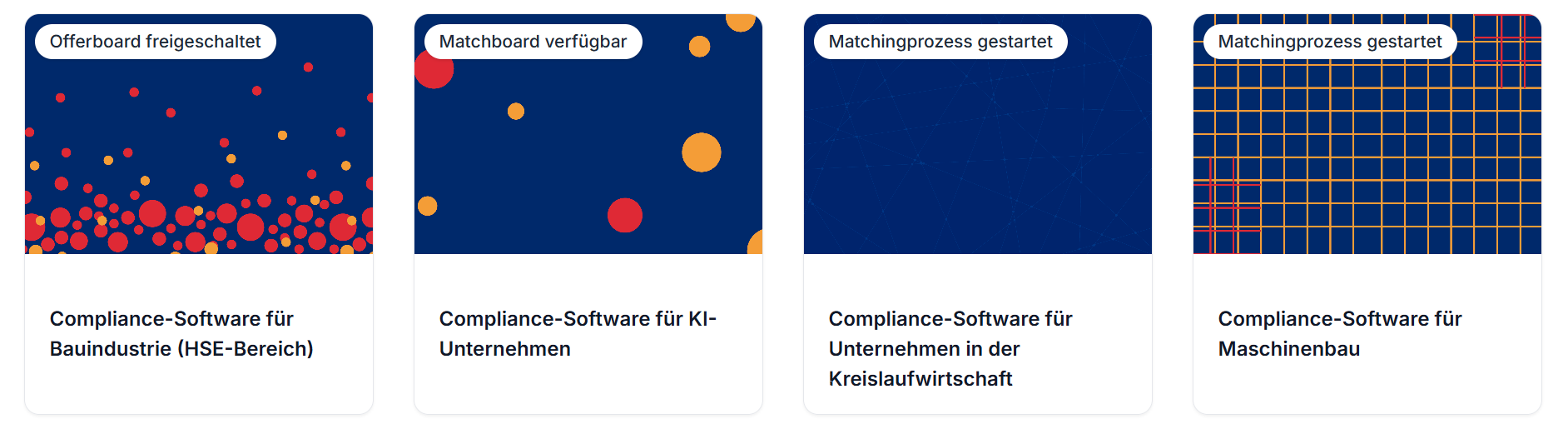
The Matchilla platform can be used for an official software tender. In addition to provider information, you also collect the corresponding offers—aligned with your own compliance rules—directly on the Matchboard. Using the invite function, you can share the offers not only transparently and clearly with procurement, but optionally with everyone involved in the process within the company.

In addition, Matchilla creates an individual provider competition for your specific matching request, making prices more comparable and negotiable for you. That will make both procurement and the boss happy!

Our selection process is based on an efficient interaction of data, algorithms, and a solid portion of personal expertise. Thanks to the number of matching processes already completed, our data basis is unique. In addition, no Matchboard is released without one of our experts adding their own input. Even companies that have already spoken with several providers are surprised by even more suitable options that haven’t been researched yet.

Think of Matchilla as a neutral sparring partner in this software selection process. We want your company to use the services of the Matchilla platform for many more future searches for service providers. That’s why we are strongly interested in ensuring that you not only have access to an excellent procurement process, but also ALWAYS find the best possible providers through us.

Simply start by filling out the Match Assistant. This gives us an initial insight into your requirements. We will contact you personally if further specifications are needed. This allows us to refine the selection criteria and feed additional, individual decision factors beyond the standard data into the matching. Based on the aggregated information, we create the Matchboard on our platform with the tool providers most relevant to you.

Picture of Compliance and software expert
Compliance and software expert

René Kühn is the founder and Managing Director of Matchilla. With his team, he has built one of the best market overviews for compliance service providers on the matching and procurement platform.

CSRD, Lieferketten, EUDR, ESPR, PPWR, CBAM & Co. sind Themen, die alle Unternehmen betreffen. Wir teilen im MatchZINE unser geballtes Wissen aus über 700 Matchings für Mittelständler und Konzerne.

More GRC articles from MatchZINE