No-code tools – why your MarTech stack needs this software
No-code? Low-code? Citizen developers? You can find out what these terms are all about and…
carefully and skillfully organised MarTech stack is essential for you as an influencer marketer. It may seem paradoxical at first: isn’t collaborating with influencers more about personal, human communication and trust? Yes, exactly! And influencer marketing software provides you with the structures for better processes and measurable KPI exchange. Only with the help of tools can you find, among the masses of influencers, the people who are on the same wavelength as your company and your communication.
The MarTech offering in influencer marketing has increased explosively in recent years. The influencer software landscape ranges from specialised tools for analysing, planning and managing influencer relations to comprehensive all-in-one solutions. Are you still looking for the right tool? In this article, you’ll find out what matters when choosing, which influencer software makes sense for which use case, and with our matching we show which providers actually fit your challenges.
Not every influencer is a fit for every campaign, every company, and the compliance guidelines, which is why a large part of the work in influencer marketing is research. And that follows a whole range of very different parameters such as authenticity, following, engagement, and of course, industry.
Done manually, this can become a lengthy and, in the long run, confusing process. Software for influencer research and influencer mapping gets you to the goal faster. You can choose between two approaches:
Research by topic
There are tools you can use to search for influencers by topic. For example, you’ll be shown who shares particularly popular content on social media.
Research by performance
Alternatively, you can use tools to specifically identify influencers who meet certain criteria in terms of follower count, authenticity, or engagement. Tools can, for example, detect fake followers or provide information about an influencer’s authenticity via a score.
Tip: More and more companies are choosing to work with multiple micro- or nano influencers with few, but more personally engaged followers in a thematic niche instead of individual mega influencers with many followers, but less potential for identification and much broader content. The reason: Younger target groups in particular appreciate the higher credibility and approachability of smaller influencers. High follower numbers are therefore not the only criterion when choosing influencers – don’t be dazzled by such vanity metrics!
If your company works with many influencers at the same time, things can quickly get chaotic. Who published which posts, and when—and what’s the current status of the collaboration? What’s still missing, and from whom? And what about compensation?
Influencer relationship management tools make your work easier: they help map the lifecycle with each influencer and centralize communication within the team and with influencers. For example, email sequences are automated and previous correspondence is logged. This makes communication easier and traceable for later analysis.
Content management is a key component of social media marketing. When collaborating with influencers, coordinating content can quickly become more complex. After all, companies usually don’t have access to influencers’ social media accounts, but still want specific content, moods, or products to be promoted.
Campaign management tools help here by enabling the exchange of content and revisions between you and the influencers on one platform. This helps you reach the goal faster and with less stress—which is better for everyone involved!
An important aspect of influencer software is coordinating different influencers who promote different brands. This way, you can manage multiple accounts and marketing campaigns centrally with one tool—without ever losing track.
Using natural language processing, AI tools can analyze the quality of influencer content. The text of the posts is checked for language, tone, and relevance and adapted to the target audience. The relevance of the content is also assessed, and the tool decides whether the desired content-related quality management is sufficient. Make use of AI!
Last but not least, there are smart tools in influencer marketing that support the analysis of campaign performance. Instead of manually checking individual metrics or arranging tedious reporting cycles with busy influencers, tools evaluate campaigns in real time and measure success. This way, everyone involved saves time and gets clear figures on the collaboration.
Of course, the influencer tech landscape also includes tools that cover all sub-disciplines and support you as comprehensive one-stop shops throughout all phases of influencer marketing.
Such software serves as a go-to hub for recruiting influencers, enables target group analysis, and simplifies collaboration as well as reporting.
Influencer marketing suites also make it easier to manage influencer campaigns end-to-end, including filterable lists, influencer selection, portfolio building, and portfolio management.
To make your search easier, we’ve compiled the most important criteria for your research. Or take the free Match Assistant for influencer software providers.
Price
How do the costs vary depending on the number of users and the scope of the features?
Support
Is there an option for support or a dedicated contact person?
Focus
Does the tool provide a specialized solution for a specific area, or is it an all-in-one solution?
Feature set
Are all important core features included? Are there any unique special features? Are there interfaces to other tools?
 Integration
Are there interfaces to other tools? Can the tools be integrated into the existing MarTech stack?
How it works
What about how it works? Is the user interface designed to be intuitive enough?
Tip: Use the free trial periods that influencer tools usually offer. Providers are often open to discussion here, for example when it comes to an individual extension of the trial period or expanding the number of accounts.
As a marketer, you’re now faced with a choice: If you want to improve individual areas in your influencer marketing workflow, influencer tech solutions can help by automating partial steps and, for example, reducing manual research or analysis effort. The biggest advantage of these tools over all-in-one solutions is usually a broader feature set for that specific sub-area.
If, however, your goal is to manage the entire influencer marketing process in one central system, comprehensive influencer marketing software may be the right choice. Otherwise, using multiple tools will create data silos.
As you can see from this content, we’ve been working on the topic for several weeks and carefully and regularly screening the provider market. We make the data collected from our research as well as the selection criteria available through our Influencer Marketing Match Assistant. This way, you’ll quickly get an overview of who the most relevant providers of influencer marketing software are and what costs you can expect. Any questions? Matchilla is here for you!
Start matching according to your criteria free of charge, with no obligation and, as part of your match request, anonymously via our matching assistant – you decide for yourselves, after reviewing the results, which influencer software provider you want to enter into further discussions with or start a trial phase with. Save yourself sales calls, automation emails and time with provider matching on Matchilla! #LetsMatch
Providers in matching: 28
You want to optimize your influencer marketing and are looking for suitable software providers? As in all MarTech areas, the influencer software market is also growing rapidly. According to our research, there are around 50 tool and software providers in the German-speaking region – which doesn’t make it easy for you to find exactly the right partner.
However, all influencer platforms can be categorized into four different categories that target different points in influencer marketing: influencer research, influencer relations, campaign management, and influencer analysis. In addition, there are providers that offer larger influencer marketing suites. These cover several functions at the same time. So at a certain point, you need to decide: Do you choose different point solutions or an all-in-one solution?
Â
First, you should determine your status quo: What works well in influencer marketing and in working with influencers? What should be optimized? Are you simply not finding the relevant influencers? Do problems arise in the collaboration? Or perhaps you’re only just looking to start with influencer marketing?
After that, you can filter which category of tools you need or which software you should switch to. If you haven’t done any influencer marketing yet, influencer research is the main focus. If collaboration is where things get stuck, you probably need a solution for influencer relations. If you don’t even know what influencer marketing brings you, an analysis tool is at the top of the priority list. If campaigns aren’t running to your satisfaction, a campaign management tool is a must-have.
Then you can start looking for the specific software. Our MatchASSISTANT above will support you with this.
The Matchilla team regularly screens the software providers in this area and identifies the most important criteria that should be discussed and defined before making a selection. A selection of questions you should ask yourself:
What would you mainly like to use the software for? Influencer research and mapping, influencer relations, campaign management, or influencer analytics
Does the software need to be GDPR-compliant?
In which languages should the user interface be available?
Are statistics important to you?
If you have already taken a closer look at the features of influencer marketing software, which features do you absolutely need? E.g., real-time analytics, social media monitoring, e-commerce integration, email marketing, workflow management, content management, influencer segmentation, etc.
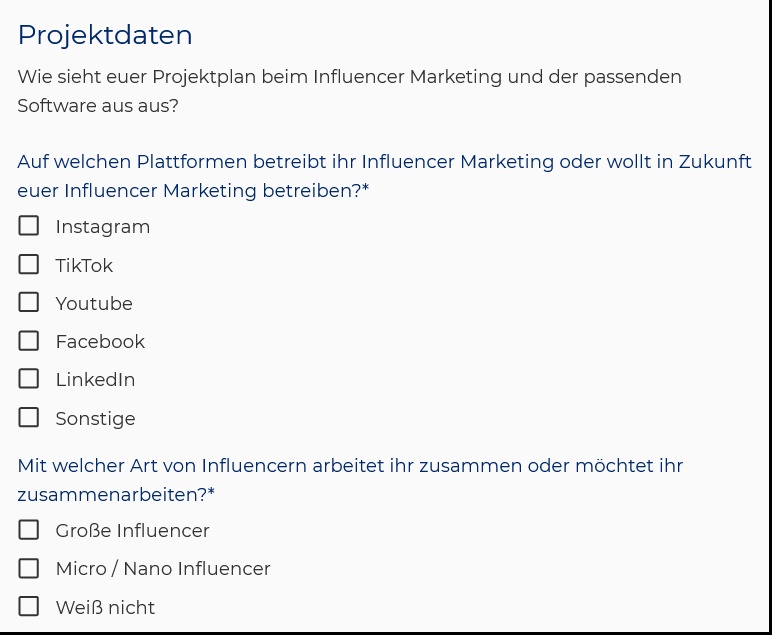
On which platforms do you run influencer marketing, or would you like to run your influencer marketing in the future?
What type of influencers do you work with, or would you like to work with?
Will multiple people in the company use the software? Do you need user management?
Are you specifically looking for German or European providers?
Where should the servers be located? (Germany, Europe?)
Do you need comprehensive support services?
Would you like to receive personal advice from the provider?
Would you like to implement the project with an agency?
By when should the software be integrated?
What monthly budget range would you like to stay within?
Which existing systems do you need an interface to? (CRM, social media tools, etc.)
For data protection or support reasons, would you like to choose a European or German provider? As with many MarTech solutions, the German and European market continues to grow and grow. If you select Europe or Germany in our MatchASSISTANT, you will receive a corresponding matching.
Simply use Matchilla’s free MatchASSISTANT with no obligation, or sign up on the Matchilla platform. Our database includes only the truly relevant providers that are matched to your criteria. This service not only helps you choose the right tool, but is also a perfect preparation for future work with the influencer marketing platform.
Give it a try—we look forward to matching with you!
Till Zier is CPO at Matchilla and, as a MarTech expert, reports in MatchZINE on news and trends in marketing, automation, analytics, and data.
No-code? Low-code? Citizen developers? You can find out what these terms are all about and…

The buzz around ChatGPT shows that AI writers are no longer a thing of the…

Corporate Social Responsibility (CSR) and sustainability management pose new tasks and requirements for companies. The…
Match me if you can!