Compliance software – matching the best systems and tools
Are you looking for a compliance management system that optimizes your processes? We’ll…
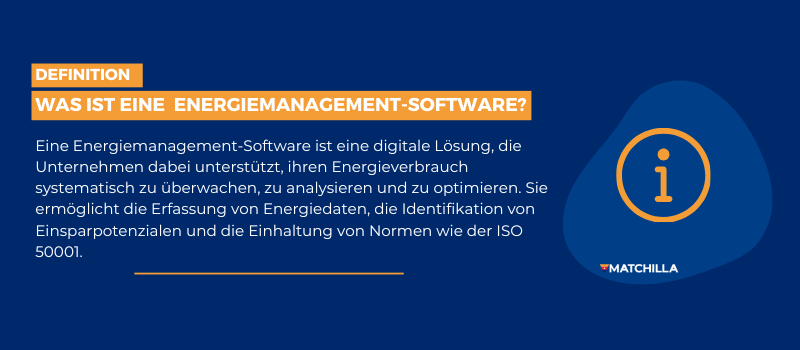
n times of rising energy costs, growing environmental awareness and regulation, efficient energy management is becoming increasingly important for companies. The international standard ISO 50001 provides a structured framework for systematically monitoring, analyzing and optimizing energy consumption. However, without the right software solution, implementing this standard is often a major challenge.
Energy management software makes it easier to capture and evaluate energy data, automates processes and helps identify savings potential. However, the market for tool providers is opaque, and identifying the right solution for your own criteria is a real challenge.
In this guide, we help you get a better overview and share our experience from over 700 ESG and EHS matchings for SMEs and corporations as part of an individual software matching, where you can find the providers that best fit you.
Would you like to dive deeper into the topic of energy management and ISO 50001? Then you’ll find all the relevant information here. Alternatively, you can start our free matching right away to identify exactly the energy management software providers that fit your individual requirements:
Rising energy costs, stricter legal requirements, and the pressure to operate more sustainably—companies are facing major challenges when it comes to their energy consumption. Since January 1, 2024, one rule has been clear: businesses with an annual energy consumption of more than 7.5 GWh must implement an ISO 50001-certified energy management system. This is stipulated by the Energy Efficiency Act (EnEfG). And the deadline is approaching: at the latest 20 months after the EnEfG comes into force, the guidelines and standards must be implemented.
In addition to ISO 50001, accompanying and supplementary guidelines are often added (including ISO 50003, ISO 50006, and ISO 50015), which companies must consider in their energy management and also in their energy reporting.
But how can reporting and energy management be implemented efficiently without losing track? This is where energy management software comes into play. Instead of laboriously recording data manually, tools enable automatic monitoring, analysis, and optimization of energy consumption. Companies gain transparent insight into savings potential and have significant advantages when it comes to fulfilling their legal obligations more efficiently.
In short: With suitable energy management software, energy reporting does not become an annoying obligation that simply has to be met, but an opportunity to reduce costs in the long term, conserve resources, and position the company sustainably.
ISO 50001 is an international standard for energy management systems (EnMS) that helps companies systematically record, analyze, and sustainably optimize their energy consumption. The standard’s main objective is to continuously reduce energy consumption and the associated emissions.
For this reason, the standard sets out specific requirements for companies and calls for a structured and traceable approach to energy—from data collection and analysis through to documentation and review of measures.
Three of the most important requirements include:
Measuring and monitoring energy values
Planning energy consumption
Implementing an energy management system
Energy management software is indispensable for implementing all relevant ISO 50001 requirements. It creates transparency regarding relevant energy data, analyzes it in a targeted manner, and supports the continuous improvement of energy performance. This covers everything you need to consider for ISO 50001 certification.
In German-speaking countries, there is a wide range of software providers that support companies in setting up efficient energy management and meeting the requirements of ISO 50001. These software solutions help businesses monitor their energy consumption, identify potential savings, and continuously improve energy efficiency.
However, it is difficult to determine the exact number of providers, as the energy management software market is highly dynamic and continues to grow. New technologies, legal requirements, and rising sustainability targets mean that new software solutions are regularly developed or existing systems expanded. Nevertheless, a current look at the market shows that in Germany alone there are currently around 100 different providers—and the trend is rising.
The wide variety of software solutions does not make the decision for the right tool an easy one. This is because the offerings differ not only in their technological focus, but also in their range of functions and target group.
In principle, energy management software solutions can be divided into two main categories:
All-in-one solutions
These comprehensive systems offer a fully fledged energy management package and cover all key functions—from data analysis and automated reporting to integration into existing IT systems.
Modular systems
Here, companies can choose individual software modules specifically tailored to their individual requirements. This offers greater flexibility, but often requires careful planning and alignment with existing systems.
Which software solution is best suited for a company depends on various factors. The decisive factors are the industry, the company size, existing IT infrastructures, and specific requirements for energy management. For example, manufacturing companies need detailed consumption analyses and load management functions, to meet legal requirements.
Fact is: Without a clear analysis of the requirements, it won’t work.
Given the large number of providers and solutions, it is essential for companies to thoroughly examine their own needs before selecting energy management software. A detailed requirements analysis that takes into account both operational and regulatory conditions helps to find the right software solution—whether a flexible modular system or a complete all-in-one platform.
Efficient energy management is more important for companies today than ever before. In view of rising energy prices, regulatory requirements, and statutory sustainability targets, businesses must systematically record, analyze, and optimize their energy consumption. This is where modern energy management software solutions play a crucial role. They enable companies to control their energy consumption precisely, uncover inefficiencies, and implement targeted energy-saving measures.
A particular focus is on ISO 50001, the internationally recognized standard for energy management systems. Companies that comply with this standard benefit not only from cost savings, but also from tax advantages and an improved sustainability profile. But how exactly can software support companies in implementing ISO 50001 and efficient energy management?
Recording and visualization of energy data
A central component of any qualified energy management software is the automated collection of energy data. Modern solutions integrate into existing metering and sensor systems and collect real-time data on the electricity consumption of machines, systems and buildings, gas, water and heat consumption, peak loads as well as energy flows. In addition, tools are able to show the generation and use of renewable energy. By visually preparing this data in the form of dashboards, charts and reports, companies gain a clear overview of their energy consumption. This is a crucial step in identifying savings potential and optimizing energy use.
How does this relate to ISO 50001?
The standard requires systematic monitoring and documentation of energy consumption. Software helps companies to capture the required data seamlessly and provide it in compliant reports, breaking it down transparently.
Analysis of savings potential
The collected data serves as a basis for analyzing and identifying inefficiencies and savings potential. Depending on the software, the following analysis functions are used: comparison of consumption patterns over different periods of time, benchmarking within the company (alternatively against industry values), detection and identification of peak loads and unusual energy consumption. Qualified energy management software is therefore able to make detailed statements about savings opportunities and develop targeted measures to save energy. This optimizes energy consumption.
How does this relate to ISO 50001?
ISO 50001 requires a continuous improvement process for energy use (Plan-Do-Check-Act cycle). Energy management software facilitates this process by providing automatic analyses and reports that enable energy to be saved effectively and used optimally.
Simplified reporting
Many companies face the challenge of preparing their energy KPIs clearly and in a structured way for various internal and external purposes. Energy management software makes it possible to automatically create these reports. This saves companies valuable time and ensures that their documentation meets the legal requirements. Complete and transparent reporting—required for certifications and audits—thus becomes many times easier and more efficient.
How does this relate to ISO 50001?
For ISO 50001 certification, a regular assessment of energy efficiency, documentation of energy consumption, and demonstrable improvement of energy metrics are required. A qualified energy management tool effectively helps to meet all requirements for certification.
Integration into existing systems
Energy management is rarely an isolated topic that stands alone. In many companies, it is part of a larger management system that also includes environmental protection, safety, and sustainability. A good software solution integrates seamlessly into existing systems and helps link data from different areas—especially HSE, ESG, and ISO 14001.
How does this relate to ISO 50001?
By linking the most important environmental areas, the standard is implemented even more efficiently. Integrating the energy management software into existing systems makes it possible to consolidate all relevant cross-company data. This gives companies a more transparent overview and helps them identify problem areas.
One thing is clear: Energy management software supports companies in many ways and is an essential advantage. It helps to monitor energy consumption, identify savings potential, implement optimization measures, while also ensuring reporting and compliance. In the long term, it also delivers cost savings and strengthens trust in the company.
Energy management in accordance with the ISO 50001 standard is more than just a means of reducing energy consumption and the associated costs. It also plays a central role in a holistic corporate strategy. This is because companies that consistently implement this standard not only benefit economically, but at the same time improve their sustainability performance (ESG) and can also use the evaluated data for their environmental and safety management (HSE). Interfaces between ESG, HSE and energy management therefore form a solid basis for transparent and detailed reporting.
Energy management software offers an additional point of contact from which data can be transferred into existing ESG tools. This opens up holistic solutions that efficiently close data gaps and integrate the analysis of the collected values.
A fictional practical example: A manufacturing company with ISO 50001-certified energy management records the energy consumption of its systems in a detailed and clearly structured way using a suitable energy management tool. This effectively identifies savings potential, and targeted measures for CO2 reduction are then implemented on that basis. These figures and data are subsequently integrated directly into ESG reporting without having to carry out any additional measurements.
In addition to the sustainable use of resources, the safe and environmentally compatible operation of plants and properties is also a key corporate objective. The interfaces between ISO 50001 and HSE lie in particular in the areas of occupational safety, risk management and environmental management. Efficient energy management is able to minimize technical risks that arise, for example, due to excessively high energy usage and overloads. This gives companies the opportunity to detect suddenly increasing energy consumption in good time and initiate countermeasures in their CMMS or CAFM system, e.g. by initiating maintenance. Not only to operate as energy-efficiently as possible, but also to protect employees.
An example: A chemical company that takes an integrated view of ISO 50001 and HSE and uses the interfaces via appropriate tools not only reduces energy consumption through energy-efficient systems, but also reduces emissions of potentially hazardous substances. At the same time, the systematic monitoring of energy use and processes enables early fault detection and contributes to cost optimization.
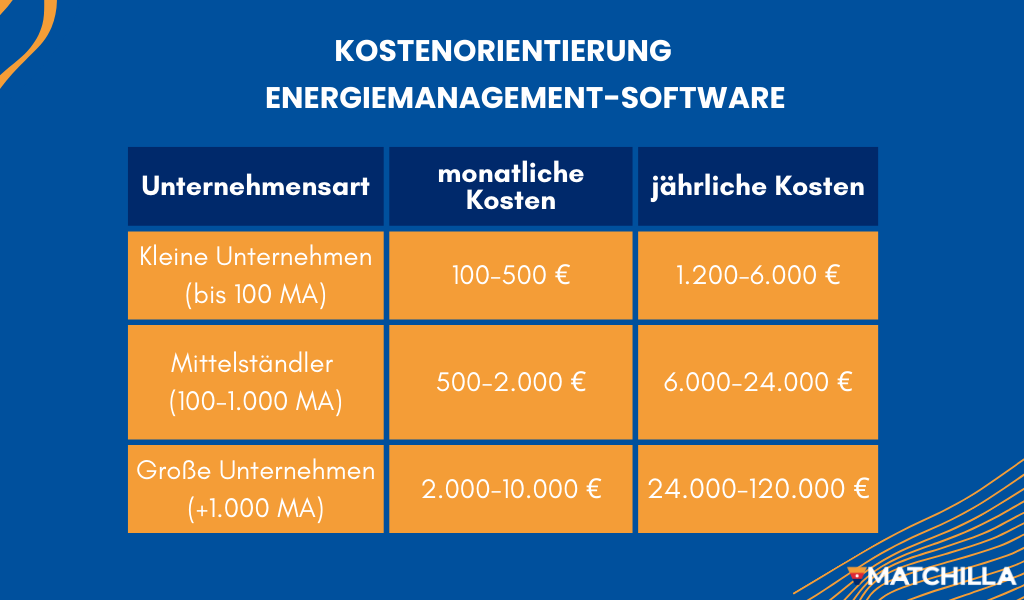
The costs of energy management software cannot be defined as a flat rate, as they depend on various factors. Every company has individual requirements that affect the price. However, we try to give you some guidance based on our most recent matchings.
On average, the costs for small and medium-sized companies range from 100 to 2,000 euros per month in license fees. Larger, energy-intensive companies or those that need to cover many metering points must expect a higher investment, as more complex software systems are required to cover all needs.
How high the costs actually are depends primarily on the factors
Company size
Scope of functions and required modules
Number of users
Support/service and training
If there are no major upward deviations in these factors, you can assume the following budgets to plan for:
A practical example:
A company with 300 employees and an annual electricity consumption of 1,000,000 kWh, at an electricity price of €0.20/kWh, currently pays €200,000 in energy costs per year. Until now, consumption monitoring has been done in manually completed documents. The required data is collected via monthly meter readings. However, peak loads, inefficient equipment and optimization potential remain undiscovered. Conversely, this means that energy is wasted unnecessarily.
After implementing energy management software for €1,500 per month (€18,000 per year), 10% of energy consumption can be saved through better transparency and automation – that corresponds to €20,000 annually.
➡ Savings potential: €1,666 per month or €20,000 per year
➡ Cost of the software: €1,500 per month or €18,000 per year
➡ ROI from year 2: 11.11% – the software pays for itself!
It must be said: The calculation is only an example and uses rough figures. Nevertheless, it is clear that energy management software not only helps to reduce costs, but also to comply with legal energy audit obligations and avoid possible fines for insufficient documentation. In addition, it effectively supports making an important contribution to the sustainability strategy.
Our recommendation at this point: Fill out our Match Assistant to get an initial overview of software solutions that fit your requirements and a non-binding budget estimate from the providers.
Comparing the best energy management software solutions for your specific requirements can be extremely time-consuming and complicated due to the wide range of options and the lack of market transparency. With our matching process, we take this burden off your shoulders. We offer a structured and effective way to find the right solution for you—quickly and with a clear focus.
Our comprehensive database includes relevant energy management tools for the German-speaking market, which we have evaluated based on hard and soft criteria such as features, modules, interfaces, industry expertise, pricing, and much more.
With our in-depth market knowledge and over 700 successful software matchings for mid-sized companies and enterprises, we offer you a clear advantage: We support you from the initial definition of requirements through to the final selection of the provider, saving you a lengthy market search.
How it works: Using our matching method, we create a shortlist tailored specifically to you (the Matchboard) that shows you the three providers that best fit you and your company’s needs. Simply fill out the Match Assistant below.
And the best part: The comparison is non-binding, free of charge, and anonymous toward the providers. Would you like to find out which energy management software will help you most in optimizing your energy consumption? Then take a moment and fill out our Match Assistant!
We look forward to matching with you!
Providers in matching: 56
Problems displaying?
Open the Match Assistant in a new window here

Matchilla’s approach is brilliant: I no longer have to laboriously research consultancies and software providers and fight my way through countless comparison portals – the right providers, so to speak, come to me – with just a few minutes of effort. The matching process saves us a lot of resources.

Finding suitable service providers via Matchilla is simple and super-fast. Got in touch, formulated the specifications, and after a few days the results were there. Through this route we got information on providers we hadn’t even heard of beforehand. Real added value.

The short, clear lines of communication at Matchilla convinced me: Our specific needs are understood immediately, perfectly analyzed, and matched with the right providers in a short time. Matchilla’s platform works quickly, smoothly, and guides you precisely through the service provider selection process.
We have explained in detail in this article what the software market in the field of energy management and ISO 50001 certification looks like. The research into provider options and the selection process are quite complex and time-consuming.
We have already successfully carried out the structured matching process that you go through with us for many companies (mid-sized businesses and corporations), and we therefore know virtually every possible constellation when searching for suitable tool providers. Due to the large number of matchings already completed, our database is unique.
With our market overview in combination with our personal expertise, you gain an immense knowledge advantage that not only saves you cumbersome research work, but also leads you to the right provider in a structured process via the Matchilla platform.
Matchilla’s service is free of charge, non-binding, and anonymized vis-à-vis the providers. The tailored assessment to select the best software for you, as well as the provision of extensive background information, is financed through the providers’ platform fees. In general, we do not have any paid contractual relationship with you. You always remain in control of the selection, as well as ending the matching process at any time.
The Matchilla platform can be used for an official tender for energy management software. In addition to the existing information about the providers, you also collect the corresponding offers that comply with your compliance regulations, directly on the Matchboard. Using the invite function, you share the offers not only with procurement, but optionally with all process stakeholders in the company.
For your individual matching request, Matchilla creates a customized provider competition, making prices more comparable and negotiable for you. Procurement, your boss, and your own budget will all be happy about that!
The selection process is based on an efficient interaction of data, algorithms, and a healthy dose of personal expertise. No Matchboard is released without one of our experts adding their own input.
Think of Matchilla as a neutral sparring partner in this software selection process. We want your company to continue using the services of the Matchilla platform for many more future searches for service providers. That’s why we are strongly interested in ensuring that you not only have access to an excellent procurement process, but also ALWAYS find the best possible providers through us.
Try it/us with no obligation – we’re looking forward to matching with you!
Ulli Theves is Head of ESG and Sustainability Matchings at Matchilla and an expert in software solutions. In the MatchZINE, he shares his expertise and regularly publishes current and useful information on the topic of energy management.
Are you looking for a compliance management system that optimizes your processes? We’ll…
Are you looking for LCA software to manage your life cycle assessment data?…
Do you want to professionalize the growing tasks in risk management with a…