BCM software: suitable tools for your business continuity management

Are you looking for software to optimize your company’s resilience through digitized and automated BCM? In our BCM software guide, get an overview of best practices for the selection process and use tailored matching to find the tools relevant to you!

B

usiness Continuity Management has evolved over recent months from a nice-to-have into a must-have. The increasing complexity of business processes and the significantly expanded range of potential sources of disruption make the professionalization and digitization of BCM processes indispensable.

For this, BCM software is almost essential—software that optimizes procedures in operational continuity management, automates numerous workflows with AI support, and enables data-driven decisions to strengthen resilience.

In this guide to selecting BCM software, we help you gain a better overview of the market and, with the help of our software matching, support you in identifying the right providers according to your individual requirements.

Matchilla - die drei Schritte im Matching

Which BCM software is right for you?

Would you like to dive deeper into the topic of business continuity management? Then you’ll find all the relevant information here. Alternatively, you can start our free matching right away to identify exactly the BCM providers that fit your individual requirements:
👉 Go directly to BCM tool matching

BCM Software 2026

Business Continuity: Why resilience leads to competitive advantages in 2026

Business Continuity Management (BCM) has gained massive importance in recent months. While companies used to work with Excel lists and static manuals, that is no longer sufficient today.

The need to invest in or modernize existing BCM software as a central tool for these processes has, due to the number, speed, and complexity of crises and risks (e.g., supply chain disruptions, the increase in the number of adverse natural events, and cyberattacks), reached even SMEs and become indispensable—at the latest since the “volatile dealmaking” around tariffs; even the BSI issues recommendations to introduce BCM software.

As if that were not enough, regulatory strictness is increasing at the same time: With NIS2, DORA, KRITIS, and further industry-specific requirements, BCM becomes subject to audits and evidence obligations. This creates additional pressure and the demand for transparency and governance: Investors, customers, and supervisory authorities expect resilience not only to be planned but also to be clearly demonstrable.

Zitat: BCM-Software

To map the core elements such as the Business Impact Analysis (BIA), conducting risk analyses, creating emergency and crisis plans, as well as preparing recovery measures and testing these plans as effectively as possible with the right tool provider, it is worth taking a closer look.

So let’s start the selection process for a BCM software solution that fits your requirements with a market overview for Germany, Austria, and Switzerland.

Market overview DACH – types of BCM tool providers

The provider market for BCM tools and systems in the German-speaking region has developed very dynamically due to the topics mentioned above. Relevant software listing portals list more than 130 BCM providers worldwide. On the one hand, this means you have a wide range to choose from; on the other hand, these overviews and lists will not help you generate a short list efficiently.

One thing up front: Many providers do not position themselves as a pure BCM system, but instead offer integrated solutions that also cover adjacent areas such as risk management, crisis communication, or emergency plans — based on experience, most matchings on our platform look for a corresponding combination.

That’s why we categorize BCM software providers into three basic types:

Matchilla - Auflistung BCM-Anbieter Specialized BCM solutions
A first group consists of the specialized BCM solutions. These providers focus entirely on Business Continuity and cover everything needed in this area: from creating and maintaining emergency manuals to conducting risk and impact analyses, through to scenarios, test exercises, reporting and control systems. They are particularly interesting for companies that want to embed BCM systematically and deeply in the organization.

Matchilla - Markt BCM-Anbieter BCM in modular GRC software suites
In GRC suites, BCM is mapped as a module. These providers come from the governance, risk and compliance world and offer platforms that bring multiple disciplines together under one roof. For companies that want to closely link BCM with their risk management or compliance processes, this is often the obvious route. The big advantage lies in integration: not a silo solution, but an end-to-end process.

Matchilla - Markt BCM-Anbieter Integrated BCM solution in enterprise suites 
An enterprise software suite covers the entire GRC, procurement, and Supply Chain process. In most cases, this is an end-to-end management solution that offers BCM functions as add-on modules. In most cases, however, Business Continuity Management is not licensable separately, but is offered as part of the overall package.

To kick off the BCM software selection process, you first need to clarify which functions will have the biggest impact for you, which departments (e.g., Procurement, Quality Management, Sustainability) are involved, and what your short- and long-term goals are. From this, a realistic needs assessment can be derived to find the right solution in the respective software category—one that fits your criteria and budget (more on ROI later).

Aside: BCM vs. risk management: the key differences

We would like to make it even clearer at this point that the two management disciplines risk management (ERM) and business continuity management (BCM) are closely intertwined. Because in tool selection processes, the two are often treated as equivalent in terms of functionality, but they actually refer to different concepts—and therefore also different types of software and functions. So here is a brief distinction for clarification:

BCM focuses on emergencies: What happens if critical processes suddenly fail—whether due to cyberattacks, natural disasters, or technical defects? At its core, it is about ensuring the company’s ability to act. To achieve this, BCM develops concrete plans, defines emergency processes, and ensures that companies can continue to operate even under extreme conditions. The focus is less on probabilities and more on preparedness and response capability.

Risk management starts earlier. It identifies and assesses potential hazards before they occur and helps to minimize their likelihood and possible impact. The emphasis is strongly on prevention and strategic decisions: Which risks does the company accept, which are reduced, and which must be actively prevented?

What is the difference between BCM and risk management

Risk management provides answer(s) to the question: What could go wrong, and how do we prevent it?

With BCM...

the aim is to answer “What do we do if it happens?” and respond accordingly.

Given the many overlaps in content and opportunities for complementing each other, it is only consistent—and recommended—that one of the most frequent matching requests on our platform in the GRC area is the search for a BCM tool in combination with a risk management software.

However, especially for SMEs, it makes sense to start with just one of the two types of software in order to keep the initial effort as low as possible and to focus only on what is absolutely necessary.

The most important functions of BCM software

Business continuity management thrives on clarity and good preparation. This is exactly where qualified software comes in: it consolidates information, structures processes, and in an emergency makes the difference between hectic improvisation and purposeful action. Anyone who implements BCM software lays the foundation to ensure that crises cannot be prevented, but can be managed much better.

Now let’s take a closer look at the key functions:

Matchilla - Supplier Relationship Management Software Funktionen Basic risk and process analysis
BCM software creates transparency across the entire organization. Critical business processes are captured in detail, including their dependencies on suppliers, IT systems, locations, or key individuals. Risks such as failures, disruptions, or external threats are not only documented, but also assessed in terms of probability of occurrence and potential impact. This creates a map of vulnerabilities that makes it immediately clear which processes are particularly in need of protection.

A retail company uses the software to capture all IT-supported sales processes. When a major cloud provider suffers a widespread outage, the analysis immediately shows which branches and services are affected. At the same time, alternative systems become visible that can be activated as an interim solution. Instead of days of chaos, a clear course of action emerges within just a few hours.

Matchilla - Matching-SRM-Funktionen Emergency and recovery plans
The core of a functioning BCM lies in clear instructions for action in an emergency. BCM software makes it possible to store emergency plans and procedures centrally, update them regularly, and make them accessible to all relevant people. This is not just about checklists, but also about graduated scenarios: How do you respond in the first moment of an outage, which steps follow after 30 minutes, an hour, or a day? The recovery time for systems and processes (Recovery Time Objective, RTO) is also clearly defined.

An international IT service provider is hit by a ransomware attack. Thanks to the recovery plans stored in the software, teams can immediately see which systems need to be restored as a priority. Responsibilities are clearly assigned, communication chains are established, and recovery times remain within the previously defined limits—significantly limiting the damage.

Matchilla - Matching-Plattform und Marktplatz Automated alerting and communication
In a crisis, speed is decisive. BCM software often integrates comprehensive alerting and communication functions for this purpose. This ensures that affected employees or external partners are informed simultaneously via various channels (e.g., SMS, push notification, email, or phone chain). Feedback can also be captured so that those responsible immediately know who is available and who needs support.

A power outage brings an insurance company’s headquarters to a standstill. Via the software, all employees receive a message within minutes with instructions on how to behave and a reference to alternative workplaces. At the same time, the feedback function shows the crisis team which people have already been safely informed. This prevents valuable time from being lost due to repeated follow-up inquiries.

Matchilla - SRM-Funktionen Reporting and compliance evidence
Crisis management is not only an operational task but also a matter of demonstrability. BCM software provides extensive reporting functions that show how well the company is prepared. Tests of emergency plans, training sessions, exercises carried out, and recovery times can be documented at the push of a button. This builds trust with supervisory authorities, customers, and business partners.

A financial institution is audited by the supervisory authority. Instead of a lengthy manual search for documents, the software generates a report within just a few minutes containing all relevant information: tested scenarios, documented results, improvement measures, and compliance with regulatory requirements. The audit runs smoothly – a clear competitive advantage in a regulated environment.

The most important functions of BCM software work together, form interfaces to other relevant areas (e.g., risk management, compliance), and create a stable foundation for crisis resilience. The BCM tool is therefore an important cornerstone for keeping your company capable of acting in critical situations.

This means: Anyone who invests in powerful BCM software not only gains crucial time in an emergency, but also establishes a day-to-day culture of transparency and preparedness that goes far beyond regulatory obligations.

Budget and ROI: What does BCM software cost?

The costs of software vary greatly and depend on many factors. Although some tool providers communicate their licensing model transparently, they are not directly comparable when it comes to pricing due to the different components involved. Looking at past matchings for our platform users, we arrive at a range between 500 and 25,000 euros in monthly licensing costs. Ultimately, how much you need to invest in a BCM tool depends on the company’s specific circumstances and requirements.

Factors that influence the cost of BCM software include:

Aufzählungszeichen BCM Kosten Risk structure
Aufzählungszeichen BCM Software Kosten Required functions / modules
Aufzählungszeichen BCM Software - Referenzen Number of access rights
Aufzählungszeichen BCM Kosten Support and training services
Aufzählungszeichen BCM Software - Referenzen Individual support
Aufzählungszeichen BCM Integration into existing systems

For a better overview, we have determined an approximate price range within which the investment falls:
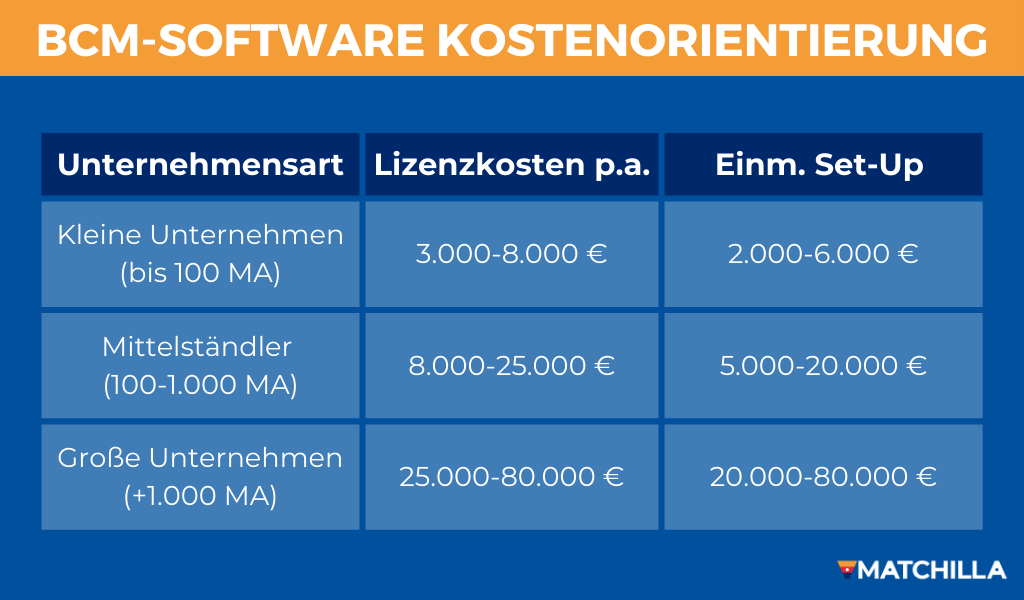
BCM-Software: Kostenübersicht

At first glance, an investment in BCM software does not seem to have a direct financial return. Especially when the implementation is primarily done to meet legal requirements, the benefit initially seems abstract – the only apparent saving is the reduced manual effort, for example in maintaining Excel spreadsheets.

However, an illustrative ROI calculation quickly shows: the investment can pay off after a short time.

ROI-Rechnung für eine BCM-Software

Ausgangssituation / Unternehmensprofil
Mitarbeitende500
Aktueller StandKritische Prozesse und Lieferketten werden bislang manuell in Excel gepflegt; Aktualisierungen erfolgen unregelmäßig
Risikoexposition2–3 größere Ausfälle pro Jahr (z. B. Lieferkettenprobleme, IT-Störungen), durchschnittliche Kosten pro Ausfalltag: 100.000 €
ZieleZentrale BCM-Datenbasis, schnellere Reaktionsfähigkeit, weniger Ausfalltage, Audit- & Compliance-Sicherheit, skalierbare Notfallorganisation
Investition in Software (einmalig)
Einrichtung / Implementierung5.000 €
Schnittstellenanbindung / Customizing5.000 €
Schulung / Einführung / Onboarding5.000 €
Gesamtkosten einmalig15.000 €
Jährliche Kosten (wiederkehrend)
Lizenzkosten10.000 €
Support / Wartung5.000 €
Gesamtkosten jährlich15.000 €
Einsparungen & Nutzen pro Jahr
Reduzierte Produktionsausfälle100.000 €
Weniger Wiederanlaufzeit (ca. 30 % kürzer)15.000 €
Reduzierte Vertragsstrafen / SLA-Kosten10.000 €
Compliance- & Audit-Vorteile5.000 €
Effizientere BCM-Pflege (weniger Excel-/Abstimmaufwand)0 €
Gesamtersparnis130.000 €
ROI
Investition Jahr 130.000 € (15.000 € einmalig + 15.000 € jährlich)
Investition Jahr 215.000 €
Einsparungen130.000 € / Jahr
ROI / Break-evennach erstem vermiedenen Ausfalltag (≈ 100.000 € Nutzen)
Einsparungen ab Jahr 2115.000 € / Jahr netto

It is becoming clear: BCM software is more than a cost factor—it is a strategic investment. In addition to reducing downtime, which is of course abstract at the moment, and the savings achieved through automated processes, it primarily creates intangible added value: greater resilience, increased trust among customers and partners, and better compliance.

The return on investment therefore becomes apparent not only in clearly measurable metrics such as lower downtime costs, but also in long-term competitive advantages. Companies that invest early in a BCM tool not only secure their operational capability, but also strengthen their market position sustainably.

BCM software comparison: How to find the right provider

The market for BCM software is opaque and complex due to the possible combination with GRC or risk management suites. In the DACH region alone, over 50 providers can be considered relevant. To help you find the right solution in a targeted way, we turn the tables and match the best providers according to your criteria.

We know the BCM software market and support you in your selection with our software expertise!

With our matching process, we offer you a structured and effective method for finding the right SRM software solution for you. We draw on experience from over 700 matchings for mid-sized companies and corporations, as well as a unique database of functions, interfaces, industry expertise, prices, and much more on the respective tool solutions.

Vergleich Risikomanagement- Software über Matchilla

Targeted matching for BCM software

After entering your criteria in the following Match Assistant, a shortlist (we call it a Matchboard) determines which three providers best fit your situation. You then choose for yourself which tool you want to take a closer look at during the quotation phase.


The best part: This individual software comparison is  non-binding, free of charge, and anonymous vis-à-vis the providers.

Would you like to find out which BCM software can best support you in optimizing your business continuity management? Then take a few minutes and fill out our BCM Match Assistant below, or register on the Matchilla platform!

We look forward to matching with you!

BCM tool matching according to your individual criteria

Providers in matching: 66

Christian Batz - Kundenstimme Matchilla
Christian Batz VP Digital, igus AG


Matchilla’s approach is brilliant: I no longer have to laboriously research consultancies and software providers and fight my way through countless comparison portals – the right providers come to me, so to speak – with just a few minutes’ effort. The matching process saves us a lot of resources.


Heiko Stotzel.jpg
Heiko Stötzel Global Head Social Responsibility, SSI Schäfer


Finding suitable ESG service providers via Matchilla is easy and super fast. Getting in touch, formulating specifications, and after just a few days the results were there. Through this channel, we got information about providers we hadn’t even heard of before. Real added value.


Lennard schulze schenker
Lennard Schulze Head of Marketing, DB Schenker


The short and straightforward approach from Matchilla convinced me: our specific needs are understood immediately, analyzed perfectly, and matched with the right providers in a short time. The Matchilla platform works quickly, is uncomplicated, and guides you precisely through the provider selection process.

Questions about BCM software matching

What you need to consider when choosing a suitable BCM software solution, we have explained in detail in this article: the research into provider options and the selection process are complex and time-consuming.

We have already successfully carried out the structured matching process that you go through with us for many hundreds of mid-sized companies and corporations, and therefore know virtually every possible constellation when searching for suitable tool providers. Due to the large number of matchings already completed, our internal data basis is unique and not available in any AI.

With this market overview in combination with our personal expertise in software, you gain an immense knowledge advantage that not only saves you cumbersome research work, but also leads you to the right provider in a structured selection process via the Matchilla platform.

Matchilla’s service is free of charge, non-binding, and anonymized vis-à-vis the providers for you. The individual assessment to select the best software for you, as well as the provision of extensive background information, is financed through the providers’ platform fees. In general, we do not have any paid contractual relationship with you. You always remain in control of the selection, as well as ending the matching process at any time.

The Matchilla platform can be used for an official tender for business continuity management software. In addition to the existing information about the providers, you collect the corresponding offers directly on the matchboard. Using the invite function, you then share all information not only with procurement, but optionally with all process participants in the company.

With this approach, Matchilla creates an individual provider competition for your specific matching request, making prices more comparable and negotiable for you. Procurement, your boss, and your own budget will all be pleased!

The selection process is based on an efficient interaction of data, algorithms, and a healthy portion of personal expertise. No matchboard is released without one of our experts adding their own input.   

See Matchilla as a neutral sparring partner in this software selection process. We want your company to continue using the services of the Matchilla platform for many more searches for service providers in the future. That’s why we are strongly interested in ensuring that you not only access an excellent procurement process, but also ALWAYS find the best possible providers through us.

Simply start by filling out the Match Assistant for BCM software. This gives us an initial insight into your requirements.

If you already have a catalog of criteria, you can upload it directly on the Matchilla platform. We will contact you personally if further specifications are required. The more detailed the selection criteria we have, the more precise the matching will be with the tool providers most relevant to you.

or directly invite tenders for your own BCM matching software

Picture of GRC software expert
GRC software expert

René Kühn is the founder and Managing Director of Matchilla. On the matching and procurement platform, the team offers one of the best market overviews of compliance and risk management service providers free of charge.

More software matches in MatchZINE